Showing posts with label High Mass. Show all posts

Wednesday, 19 December 2018

REPORT: Rorate Caeli Mass on Saturday, December 15, 2018 at St. Mary's Polish Catholic Church in Toronto

REPORT: Rorate Caeli Mass on Saturday, December 15, 2018 at St. Mary's Polish Catholic Church in Toronto


Hello Everyone, 

I come to you with a special report in this liturgical Season of Advent. If you have not seen this post on my blog, or examined other social media blogs dealing with the Latin Mass in Toronto, there are a number of special offerings, aside from normal Latin Masses at parishes that offer them, that have been or are to come in the Archdiocese of Toronto. In particular over 3 straight Saturdays including this Saturday past, Missa Cantata/High level Latin Masses are being offered at St Mary’s Polish Catholic Church at Davenport and Ossington area in Toronto, 1996 Davenport Road. 

Fr. Kazimirez and his parish have been great supporters of the Latin Mass, hosting their own weekly and special offerings, as well as allowing lay organizations/choirs to organize special offerings of the EF at St. Mary's (including my allies of St. Patrick's Gregorian Choir, with whom recently organized an offering for Christ the King in October 2018.) 

As I did last year, and again this year, I was privileged to have the ability to rise early in the morning, to experience one of the richest liturgies in the Extraordinary Form (EF)/ Latin Mass the Catholic Church has to offer, the Rorate Caeli Mass in Advent. 

As this year’s mass was publicly announced (on the St. Mary's website,) and held at an Archdiocese of Toronto parish, I bring to the faithful a report of the Rorate Caeli 2018 Mass in Toronto, held at St Mary’s. 


PREAMBLE: What is special/different about Rorate Caeli?

As per the Fraternal Society of St Peter, they describe the Rorate Mass as the following: 

"The Rorate Caeli Mass is a traditional Advent devotion wherein the Mass of the Blessed Virgin Mary for Advent is offered just before dawn. In many instances families and individuals travel an hour or more, rising and arriving very early for this stunningly beautiful Mass. The interplay of light and darkness speak to the meaning of Advent and the coming of the Light of the world.

The Mass takes its title, Rorate Caeli, from the first words of the Introit, which are from Isaiah 45:8:

“Rorate, caeli, desuper, et nubes pluant justum, aperiatur terra, et germinet Salvatorem.”

“Drop down dew, ye heavens, from above, and let the clouds rain the just: let the earth be opened and bud forth a Saviour.”

The Rorate Mass is lit only by candlelight. Because it is a votive Mass in Mary’s honor, white vestments are worn instead of Advent violet. In the dimly lit setting, priests and faithful prepare to honor the Light of the world, Who is soon to be born, and offer praise to God for the gift of Our Lady. As the Mass proceeds and sunrise approaches, the church becomes progressively brighter, illumined by the sun as our Faith is illumined by Christ.

The readings and prayers of the Mass foretell the prophecy of the Virgin who would bear a Son called Emmanuel, and call on all to raise the gates of their hearts and their societies to let Christ the King enter; asking for the grace to receive eternal life by the merits of the Incarnation and saving Resurrection of Our Lord."


REPORT:

Upon entering the church, the whole of the body and sanctuary was covered in darkness, save the multitude of lit candles in the sanctuary, and smaller candles lit on every windowsill. 

In attendance for the actual Mass, was about 30-35 laity in the pews including myself, though with celebrant, servers and choir thrown in, that makes for a total of 40-45 people offering their prayers/participating in the sacred liturgy of the Holy Sacrifice of the Mass. 

While the numbers were about the same as last year’s attendance, I can happily say the demographic has been changing, reflecting the overall gravitas of youth and young adults seeking the spiritual nourishment that the Latin Mass provides. Last year when I attended, from a visual glance around me, I and maybe one other soul were young men under 40, the rest older parishioners of St Mary’s and women. 

This year, when I looked around, I saw two young adult couples, another young man from (my first MC’d) October Christ the King Mass, and another young man with a relative (perhaps one of the acolyte’s brother and mother?) For a smaller crowd at a EF this is a marked jump in demographic, and proof that giving solid liturgy to the youth attracts them to the church, so much so to get them out of bed on an early Saturday morning, and forsake their favourite past-time of weekend sleeping in! 

As for the liturgy itself, every member on the altar was nearly flawless in their execution of the liturgy. Though I would not expect nothing less from pastor Fr Kazimierz who has been doing the EF a few years now, and the serving corps of whom most members I have has the pleasure at serving at the altar of the Lord with. Those servers are all veterans in our diocese, made of a combination of parishioners of St Mary’s and have assisted masses of (in most cases) all lay organizations/choirs who organize Latin Masses in Toronto, and those involving the EF chaplains of past and current in our Archdiocese. 

The choir was sacred and sanctimonious in their chanting of the hymns, propers, and the chosen Mass setting IX: Votive Mass for the Blessed Virgin Mary 1. Mass setting IX was fitting as the sound of the setting has a strong, yet docile and tempered pace, well suited to the gradual rising of the sun and illumination of the parish interior over the Mass. 

As per usual in my reporting, to give you a sample of immersion into the Latin Mass, I post here some of the main posts of the Homily by Fr Kazimierz from my recollection:
  • Even in the Old Testament God allowed for many miracles out of love for his holy people and to give hope to all of us, the faithful. 
  • Examples are the exile of the Jews out of Egypt from their Egyptian captors as well as the parting of the red sea.
  • God continues to show his love and mercy and hope for the people of the faithful even in the time after king David. He did so with Achaz as in the Epistle of the Mass (Isaias 7:10-15.) Surrounded by their enemies, God nonetheless gave to Achaz and the Jewish people, a sign of hope and promise forelling of the coming of Christ being born to the blessed virgin Mary. 
  • With Regards to Mary and her Fiat, She was open to the Lord’s grace, his blessings, and mercy, in accepting the great task and privilege of bearing Jesus Christ in pregnancy. Mary is the mother of God because of His own incarnation, of Christ being born of the blessed virgin Mary.
  • In this time of Advent me we to reflect on the blessed virgin Mary’s obedience to our Lord and may we be open to his divine well as was Marie when she in obedience excepted being the mother of God and mother of Jesus Christ.

In all, this liturgy was a beautiful way for one to prepare themselves to celebrate his nativity on Christmas Day. It contained a beautiful serenity, so much so, that after I consumed the Lord in the Sacred Species of the Eucharist, I felt a movement of peace and warmth within me after reading some post-communion prayers from my old pre-Vatican II prayer Missal, “The Key to Salvation.” This Sacred liturgy was definitely the “warm cup of cocoa” to melt the spiritual cold of one’s heart and there is no one better (save Christ) to do so than His Holy Mother, the Blessed Virgin Mary, the key focus of the Rorate Caeli Liturgy. 

If one wishes they could come to such a sacred liturgy you have one more chance this coming Saturday, December 23, 2018. Fr Kazimierz will be celebrant for another Missa Cantata at St Mary’s Polish Catholic Parish. This liturgy will also be special as it is an Ember Saturday for the Season of Advent (of the Winter ember days,) containing five Scripture readings prior to the Gospel. There is still time to prepare one’s heart and mind, spiritually, this Advent, with a gorgeous and sacred Latin Mass in the Archdiocese of Toronto.

Enjoy the accompanying pictures. Of note: notice the smoke of the incense rising up in the candlelight of the altar, and that the stained glass window over the altar has, in it's center, but who else ... the Blessed Virgin mary 

Pax Tibi Christi, Julian Barkin. 


PS. As to the prayer I was reading after consuming the Sacred Host, this is the prayer from “The Key To Salvation,” “Act of Love:“ O beloved Jesus, where shall I find words to express my gratitude and love? O inestimable pledge of God's love for man! O inexhaustible fountain of divine graces! O boundless mercy! O divine charity! Hail O merciful Jesus! O may my soul be sensible of Thy adorable presence and may I see how sovereingly sweet Thou are in the sacrament of Thy love. Yes, O God of goodness!  I love Thee with my whole heart, my whole soul, and above all things. O divine Jesus, do Thou confirm these holy resolutions in my heart, and frant that I may always be able affectionately to exclaim with Thy holy apostle: Thou knowest, Lord, that I love Thee. 

Saturday, 18 August 2018

High Mass/Missa Cantata in Archdiocese of Toronto Saturday, August 25th 1230pm EST

(Source: https://achristianpilgrim.files.wordpress.com/)

Hello everyone,

I would like to announce another special offering of the Latin Mass (Extraordinary Form of the Roman Rite, herein the "EF") in our Archdiocese of Toronto, happening before Summer’s end. While I will not be involved liturgically (full serving compliment!,) others whom I have served with will be assisting at the altar of our Lord for this Mass.

The offering of this Latin Mass will be at the level of Missa Cantata/High (Sung) Mass, with Fr Russell Asch, Chaplain of the EF in the Archdiocese of Toronto as Celebrant.

The date and time of this offering is Saturday, August 25 at 12:30 PM. This will be held at the chapel for the Carmel Heights Seniors' facility located in Mississauga at 1720 Sherwood Forest Circle. Follow the link for a map.

As an interesting footnote the liturgical acolytes a.k.a. altar servers as well as the liturgical music of sacred Gregorian Chant, will not be organized/provided by the usual lay organizations or choirs, who normally hold offerings of the Latin mass at the higher levels in the Archdiocese of Toronto.

The servers will be composed of young men who already serve their home parish and/or extra-parish offerings of the EF, and a choir of young adults in our Archdiocese. This is an extraordinarily positive sign! This shows that young people in our Archdiocese are willing to go the distance, with some additional help when needed, to bring full, liturgical worship that people are craving, to the faithful in our local and universal Church.

This also shows that the EF alive and well in the Archdiocese of Toronto, and has expanded beyond its normal groups and parishes in our Archdiocese, and in the overall life of the Church. Who knew this would happen back in the mid 2000’s when the EF first re-emerged in Toronto’s faith life, outside of the one 1988 "indult Mass" at St Vincent De Paul.

As an important note: NO, this does not fulfill your SUNDAY obligation. You must still attend a Saturday Vigil Mass in a Valid and LICIT rite of the Church, OR Sunday Mass including either form of the Roman Rite.

Regardless, if you are looking for that beautiful endnote to the Summer in your faith life, or are genuinely curious, come one and all to this sacred offering of the Latin Mass.
Come experience real mercy and reverence in the Latin Mass, and see that Hagan Lio Pope Francis keeps telling youth to do!

Pax Tibi Christi, Julian Barkin.

Saturday, 2 June 2018

CONFIRMED! Latin Mass Announcement! MISSA CANTATA (High Mass) for Sacred Heart THIS FRI June 8 in the Archdiocese of Toronto!


Hello everyone,

The St. Patrick’s Gregorian Choir, stationed within the Archdiocese of Toronto at St Patrick’s Catholic Church in Downtown Toronto (link to parish here,) will be organizing and providing their voices in singing the liturgical music for, their annual offering of the Latin Mass/Extraordinary Form of the Roman Rite, for the Feast of the Sacred Heart of Jesus. The details of the Mass for this feast day are as follows:

Where: St Edward the Confessor Catholic Church, Toronto (North York,) Ontario, in the Archdiocese of Toronto.
Address: 75 Churchill Ave, Toronto, ON.
When: Friday, June 8, 2018
Time of Mass: 7 pm E.S.T.

The celebrant for this Mass will be Fr Russell Asch, recently promoted to the Chaplain of the EF in the Archdiocese of Toronto, and now stationed at St Lawrence the Martyr in Scarborough (in place of transferred Fr Steven Szakacski.)

As a side note, I will be joining my friends in Faith of the SPGC choir, once again in a liturgical role on the altar, in service to our Lord.

For more information or questions, you may contact Surinder S. Mundra, choirmaster of SPGC at 416 731 4485. In addition, should you be interested in participation for this mass or in future, via serving or singing, you may also contact Surinder who will connect you for the appropriate part of the Mass (serving/singing).

You may also contact me at my blog e-mail (torontotlmserving@gmail.com) and I can put you in touch with Surinder and/or those in charge of serving for these Masses. Be advised if you desire to serve this Mass, you must have availability for Wed June 6 in the evening for a practice, site TBD. At this point any additional servers would be likely a boat bearer, in choir, or as torchbearers as it is now confirmed a complement of 5 servers (including myself) will be assisting.

For anyone and everyone else, please come and attend and encourage your friends to attend. I hope you will take the time to partake in this sacred event and be moved by the EF and all its parts on the altar. This will truly give you a taste of Heaven on Earth!

Pax Tibi Christi, Julian Barkin.

Thursday, 7 December 2017

Upcoming Additional Missa Cantata/TLMs for December 2017 in Toronto Outside of Normal TLM Parishes

Hello Everyone,

Thanks to one of my closest of friends, a confidant I can trust in the TLM, I have been informed of some upcoming Missa Cantata offerings in the Latin Mass for the liturgical season of Advent.

After contacting the parish office during the week by email, as well as the pastor himself by phone (surprised calling the main line I got him! Now that's being "pastoral!") to verify the offerings, especially one in particular, I can confirm the following offerings for the TLM, which are ALL being hosted at St. Mary's Polish Catholic Church at 1996 Davenport Road, in the Archdiocese of Toronto. The following offerings have been confirmed:

Solemnity of the Immaculate Conception - Friday Dec 8, 2017
  • St. Mary's Polish Catholic Church, 1996 Davenport Road. 7:00 PM E.S.T. Start Time. 
SPECIAL!!! RORATE CAELI - Saturday Dec 16, 2017
  • St. Mary's Polish Catholic Church, 1996 Davenport Road. 5:45 AM E.S.T. Start Time! 
    • NOTE: Why so early? From St. John the Bapitst FSSP parish in Arkansas, USA: " The Rorate Caeli Mass is a traditional Advent devotion wherein the Mass of the Blessed Virgin Mary for Advent is offered just before dawn .... The Mass takes its title, Rorate Caeli, from the first words of the Introit, which are from Isaiah 45:8: “Rorate, caeli, desuper, et nubes pluant justum, aperiatur terra, et germinet Salvatorem.” “Drop down dew, ye heavens, from above, and let the clouds rain the just: let the earth be opened and bud forth a Saviour.” The Rorate Mass is lit only by candlelight ...." 
Ember Saturday in the Season of Advent - Saturday Dec 23, 2017
  • St. Mary's Polish Catholic Church, 1996 Davenport Road. 9:00 AM E.S.T. Start Time. 
  • Note: St. Mary`s has a weekly Latin Low Mass at this time normally, that all can attend.  
For those looking for spiritual preparation in the anticipation and coming of our Lord, why not go the distance and give our Lord a special, spiritual gift to him in anticipation of Christmas Day. Come and see what the sacred and Holy TLM is all about.

Pax tibi Christi, Julian Barkin.

P.S. I, nor those I assist in the TLM (e.g. St. Patrick's Gregorian Choir,) have any affiliation with this parish by ministry or as registered parishoners, nor have been asked by any party in these Masses for assistance with the EF liturgies. Despite my blog goals, because these offerings are being hosted by a parish in the Archdiocese of Toronto, with approval from the parish pastor (to the best of my knowledge,) and despite other online promotion of these offerings, I am promoting these offerings for those who simply want to attend some TLMs during, and in the spirit of, this beautiful season of Advent.

Saturday, 19 August 2017

REPORT: High Mass/Missa Cantata on Saturday, June 10, 2017 at 7:00pm EST

REPORT: High Mass/Missa Cantata on Saturday, June 10, 2017 at 7:00pm EST

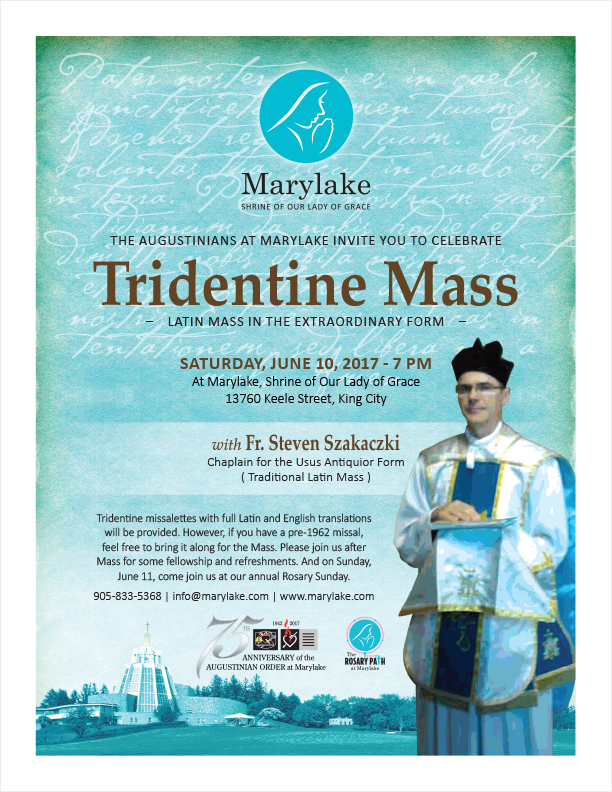
Marylake_tridentine_mass

Hello Everyone,

Allow me the privilege to release another report of an offering of a Missa Cantata/High Mass in the Extraordinary Form that occurred during the summer season. On June 10, 2017, 7:00 pm EST the Augustinian brothers of the Marylake Shrine of Gratitude, in King City, ON, graciously allowed for their annual offering of the Extraordinary Form of the Roman Rite/Latin Mass, to take place. This offering has now been offered annually, either for its 3rd or 4th year at the Shrine.

For this offering, Fr. Steven Szakaczki, head of the Latin Mass contingent of the parish of St. Lawrence the Martyr, Scarborough, and veteran priest to the Latin Mass offerings in the Archdiocese of Toronto, was main celebrant for this Mass. Servers were requested independently, via contact by the Master of Ceremonies, including I, the author of this posting, for service at the altar. For this EF liturgy, I was acolyte 2 alongside my longest friend in the Faith, who served as Acolyte 1.

Prior to the Mass Fr. Steven, and all servers in their positions, met at the Shrine for a rehearsal, and to iron out liturgical particulars between our knowledgeable Master of Ceremonies, Giovanni, Fr. Paul, who was the current head prior/brother of the Shrine (and organizer for the choir portion of the Mass,) Fr. Steven, and the servers. Ironing out these particulars was essential, as mentioned before in my prior announcement post here, this Mass fell on an interesting time of year in the EF calendar, the Saturday of an Ember week in the Octave of Pentecost, and thus some changes to the order of the Mass (readings, etc.) needed to be known to all parties involved.

The liturgical differences, due to being an Ember Saturday were:

  • On an ember day liturgy, up to 5 additional Old Testament "lessons" of Scripture are added in addition to the standard Epistle. This is followed by a collect after each lesson. As was custom before in the EF, there is the granting to the celebrant of the option of a shorter amount of only one lesson in addition to the main collect, followed by the Epistle, a tract (instead of an Alleluia), a "sequence," and then the Gospel reading. It was decided for the sake of time and unnecessary burden on all present, the shorter option was in effect.
  • A sequence was sung (being in the Octave of Pentecost) called the Veni Sancte Spiritus, before the Gospel was proclaimed. This is NOT the same as the "Come Holy Spirit ..." prayer, though ``Come Holy Spirit`` is the literal translation of the title of the sequence, based on its first three Latin words. 

Since I was not serving as thurifer, this year, and got to remain in sanctuary the whole time, I had the privilege of listening to Fr. Steven's homily in full. Here is from my recollection the main points of this homily:

  • Where we are today in the calendar of the Novus Ordo, is that we are not celebrating Pentecost anymore, but have moved back into Ordinary time during the weekdays. Unfortunately, in the liturgical changes, the Octave of Pentecost was removed from the calendar. 
  • In the Extraordinary Form Calendar, we are on the Saturday of the Octave of Pentecost, specifically the Ember Saturday. While people in both forms may have partaken in the Novenas (for Pentecost or more likely to,) the Holy Spirit, it is unfortunate that this was taken from the Novus Ordo Calendar. 
  • We should be truly fortunate in the EF Calendar to have the Octave, to be celebrating the Joy of the Feast of Pentecost, as without this truly remarkable event, there would not be the Catholic Church.
  • Before we discuss Pentecost, just what is the Holy Spirit? The Spirit is the Third Person of the Trinity, as revealed to us in the Scriptures, with intention of God and our Lord to exist, sharing the same divine nature as the other Persons. What the Holy Spirit is, is the LOVE of our Lord and his Only Son. 
    • When there is a relationship that involves love, there are three persons: the person giving love, the one receiving it, and the Love itself. 
    • God the Father, so loved all of us that He gave His Only Son to us, Jesus. God Loved his Son, and the Son loved His Father in Return, that between the two exists the Love that "spirates" from both of them, and that is the Holy Spirit. 
  • When we examine the events surrounding Pentecost, we come to the Apostles, who were vital to spreading the Gospel and hence, establishing the Church after Christ's Death, Resurrection, and even Ascension to Heaven. Even after His Ascension into Heaven, the Apostles did not go about an just make the Church happen. They were still fearful of persecution by the Roman authorities, having been so close to our Lord. Further, they likely discussed many things about their Lord, and likely still had much doubt about Him and what He said.
  • So here they were, all hiding in the upper room alongside our Virgin Mother, Mary, and some others, waiting out their days in hiding. Then, comes the very paraclete that Our Lord said would be sent to help them carry out His mission. The tongues of fire came down upon them and they were filled with those Gifts of the Holy Spirit, and the courage to go out and establish the Church, doing the Lord's work. 
  • When they went about doing the Lord's work, filled with the Holy Spirit, they did many amazing works and converted scores of people to our Lord and the Faith, even performing miracles and amazing works! 
  • So then, why do we not see many, or any, of these supposed works that happened with the Apostles after being filled with the Holy Spirit, despite many Catholics being baptized and confirmed, and receiving the Holy Spirit with the Sacraments? There are two key reasons
    • 1. TRUST - Sadly today, many people, even Catholics, do not place their full trust in the Lord, and in the Holy Spirit. They place their trust in the things of this world, or things of man, many a time being led to sin and unhappiness. The Apostles were able to place their trust in our Lord with the gifts of the Holy Spirit. 
    • 2. LOVE - When we go about doing our spiritual works, or our lives, we often do not do many things with the Love of the Holy Spirit. [Editor's note: As the Holy Spirit IS LOVE itself, then we must, as Children of God. go about with the LOVE of the Lord in our whole being in what we do, and that LOVE IS the Holy Spirit.] 
  • So, on this Feast of Pentecost, may we pray for the opening our hearts to trusting in the Lord, and the TRUST and LOVE that our Apostles exhibited when filled with the Holy Spirit, to be able to serve our Lord fully. 
All in all, the liturgy and the Holy Sacrifice of the Mass, was carried out in a solemn, reverent, and even joyful capacity, and the chapel was clearly filled with the presence of something "awesome" happening in that holy space, meeting (though not literally replicating) that very same experience the Apostles had in the upper room, being so close to our Lord and His Holy Spirit, in the Latin Mass. 

As for attendance, while not as full as last year, the chapel, which I estimate visually to be capable of holding about 200 bodies in its pews, was almost completely full, with only the odd spare seat in the back couple of pews. That is still a remarkable attendance for an offering in a Chapel, held not in the immediate core of the Archdiocese, AND had only parish posters and some internet promotion, which seems limited to this blog and my requests on some Facebook groups. When you factor all that, there is CLEARLY demand for the Latin Mass, and even some spreading, will bring out a good sizable number of the Faithful, including young people, who thanks to social media are discovering this treasure of liturgy that they rightfully deserve from the Church at large. 

This young acolyte (and assuredly, all present in the pews and involved in carrying out the sacred liturgy) are truly thankful for the generosity of the Augustinian Fathers for offering, even yearly, the opportunity for the Extraordinary Form of the Roman Rite to be offered in their shrine, in the Archdiocese of Toronto. Likewise, Fr. Paul was truly impressed and thankful for the hard work and dedication we all showed, including true reverence for our Lord in the Liturgy, our organization and efficiency in carrying out the Liturgy, and the humility we brought to the Latin Mass. 

We hope that by efforts such as the Augustinian Fathers, more offerings will become established via influence in King City, and surrounding areas of Vaughan, Woodbridge, Aurora, Newmarket, and Brampton. 

Also, it is hoped that this annual tradition will continue in future, as it has been found out that as of this summer, the prior head brother, Brother Paul, who was appreciative of the Latin Mass, will be leaving the Shrine and Br. John Paul Szura, is now the new superior/head brother of Mary Lake. It is with good hope that the new head, Br. John Paul, will continue on allowing the tradition to continue, one which will maintain good report with those who favour Catholic Tradition/the Latin Mass of the faithful in the surrounding municipalities of the Shrine and those in the Archdiocese of Toronto, and further meet the spiritual needs of those faithful and the youth, who truly want a deep and personal connection to Christ in the Liturgy. May the love of St. Augustine and the fraternal order founded on this great saint for our times, continue to thrive in our Archdiocese of Toronto. 

Thank you, Augustinian Brothers, and those in the E.F./Latin Mass for making this sacred event happen. 

Pax Tibi Christi. Julian Barkin. 

Tuesday, 6 June 2017

Missa Cantata/High Latin Mass at Mary lake Shrine in King City This Saturday June 10th, 2017 7pm

Marylake_tridentine_mass
(As advertized on https://www.marylake.com/upcoming-events?tag=Tridentine%20Mass, this is the poster that has been distributed to nearby parishes.)

Hello everyone, particularly those living in King City, Ontario, and the surrounding areas of Woodbridge, Vaughan/Maple, Brampton, Newmarket, Aurora, and Richmond Hill, 

As is now the annual tradition of the Mary Lake Shrine in King City, overseen by the Augustinian Fathers, in the month of June they allow for a yearly celebration of the Extraordinary Form of the Roman Rite a.k.a the Latin Mass. Last year I was able to altar serve that offering as thurifer and the posting of that past offering is here, where I also briefly talk about the Fathers and the Shrine.

Once again, the Augustinian Fathers will be organizing a Missa Cantata/High Latin Mass, with the offering being celebrated by Fr Steven Szakaczki, one of the main priests in our archdiocese of Toronto who celebrates the Latin Mass, and is frequently consulted for such offerings by multiple parties. Fr. Szakaczki also oversees the St Lawrence the Martyr, Scarborough, daily Latin Mass offerings. In addition, a full complement of 5 servers (MC, 2× acolytes, crucifer and thurifer,) including myself as acolyte 2, will be serving our Lord at the service of the altar.

The date of this Mass in the EF is this coming Saturday, June 10, 2017 at 7pm EST start time, at the Mary Lake Shrine of our Lady of Grace, 13760 Keele St., King City, ON, just north of Keele St. and King Rd. This will take place in the Eucharistic adoration chapel, beside the main altar/sanctuary at Mary Lake Shrine. 

Allow me to add some additional notes of generality and of the liturgy:

Generally speaking (and for the laity to attend):

  • In the Latin Mass calendar, this is "Ember Saturday" in the Octave of Pentecost. For the laity, there used to be binding laws of partial abstinence from meat and full fasting. Partial abstinence means meat is ONLY eaten at one meal/the main meal of the day. While the current Canon Code of Law of 1983, combined with the change of the Novus Ordo (vernacular) liturgy, the Papal document Paenitemini of Pope Paul VI, and the Vatican II "invention" of Bishop's Conferences, they have made these practices not binding by sin/law in today's Church. STILL, one should always be encouraged to participate in the customs and life of the Latin Mass, such as these. So if capable, do fast and partially abstain from meat this coming Saturday.
  • There WILL be confessions before the actual Mass, as the prior has been made aware. A priest will be available for the sacrament in the confessional beside the main altar

Liturgical notes:

  • At the decision of the Augustinian Fathers, the regular maximum of five servers will be maintained, with no additional servers to be added in supplementary roles such as boat bearer and torchbearers. Part of this was an organizational decision (as the sanctuary in the chapel is small,) while at the same time, it was also motivated by allowing for the richness of the liturgy to be fully seen and carried out as per the EF/TLM of 1962. Therefore, our acolytes (myself included,) will also be pseudo-torchbearers in the Mass of the Canons from the Sanctuary until after the people's communion. You will receive communion with acolytes as "guards" next to each prie deux.
  • As this is the Saturday of Ember days during the Octave of Pentecost, some interesting additions to the liturgy will happen:
    • On an ember day liturgy, up to 5 additional Old Testament "lessons" of Scripture are added in addition to the standard Epistle. This is followed by a collect after each lesson. As was custom before in the EF, there is the granting to the celebrant of the option of a shorter amount of only one lesson in addition to the main collect, followed by the Epistle, a tract (instead of an Alleluia), a "sequence," and then the Gospel reading. It has been decided that for the sake of time and unnecessary burden on all present, that the shorter option will be in effect on this day.  
    • In addition there is a sequence sung during the Octave of Pentecost called the Veni Sancte Spiritus, before the Gospel is proclaimed. This is NOT the same as the "Come Holy Spirit ..." prayer we know, though ``Come Holy Spirit`` is the literal translation of the title of the sequence, based on its first three Latin words. 
Thankfully, the more senior brothers of the Augustinians here, including the head brother, have a solid appreciation for this form of the liturgy and a good head about how one goes in celebrating this form. As just one example, while all of us servers, Fr. Steven, and the head brother/prior, were waiting outside to begin practice this Monday, Fr. mentioned that he has seen in his many years a true and reverent way of celebrating/serving the Latin Mass, and ways it has not been such. When serving or celebrating, one must not be an "actor on a stage" moving like clockwork. Your movements must not be grandiose, but smooth, and genuine, with an attitude of true humility and service to our Lord at the altar.  

I ask kindly that you please spread word of this offering by any means of communication, and bring any family and friends to this offering. I hope to see some of you there, afterwards, when we will have a post-Mass celebration with refreshments. 

Pax Tibi Christi, Julian Barkin. 

Friday, 15 July 2016

Report: High Latin Mass/Missa Cantata at Mary Lake Shrine of the Augustinian Fathers in King City, ON, Saturday June 11, 2016

shrine004

Hello Everyone,

I'll admit in light of my married life, as well as focusing on my major work whereby I had to call out a professor of OLSWA for his attack on Jean Vanier, (Part I, and Part II) this is long overdue, and I haven't had a chance to do this until now.

A month and a half ago, the Mary Lake Shrine in King City, Ontario, one of the parishes blessed with being a site of the Doors of Mercy of the Extraordinary Jubilee Year, held a beautiful and reverent Missa Cantata. The celebrant was none other than our Archdiocese's Latin Mass Chaplain, Fr. Steven Szakaczki, currently residing at St. Lawrence the Martyr Scarborough. I refer you to this link, that I had for promoting the Mass for some brief information about the Shrine and the Fathers' charism, but how blessed was the Archdiocese that these fine brothers would allow a Latin Mass. It turns out that this is their 2nd or 3rd year in a row that they have done an annual offering at the shrine of the Latin Mass, and for a yearly offering, they are happy to oblige.

I personally was going to attend with my best friend in faith, as this Mass was entirely independent of any specific organization, and being celebrated by Fr. Steven at a magnificent place. Initially, I had also inquired about serving. At that time, numbers seemed ok, but I was asked to be on "standby" later, in case of increasing the level to a Cantata with incense.

It turns out that, we were part of the Lord's plan, as a last minute change of plans necessitated me robing up and serving. We also had another young man join us who had served some other Latin Masses in the Archdiocese that my friend knew, and an old ally from our last St. Patrick's offering, just happened to show up, who was originally going to be in the pews. Thankfully, we had an extra cassock on hand and I lent my spare, cotton surplice, to him that I keep with me. With four servers, we had enough for incense and elevation to a Missa Cantata! Since none of us had the experience to do the Master of Ceremonies role, we went with two acolytes, a thurifer, and a crucifer.

Overall, we were able to give each other quick rundowns for our roles and I had crammed a little thurifer reading on the Missa Cantata just in case. For the most part, the serving went well, although without an MC, it was a bit challenging to know cuing of parts and such. The four of us are not part of an established Latin Mass program/parish so there's where the challenged lay. I also had a relative lengthy distance for the midpoint to walk for a coal exchange for the thurible, as the sacristy was near the main altar, and to get to that, you had to exit the back of the chapel, out to behind the main altar. Thank goodness Fr. Steven is a master of the Latin Mass! He led us fantastically in the Mass, and we were able to carry out a beautiful Missa Cantata.

However, a Mass isn't just priest and servers alone. I also give mention to the choir and the crowd. The choir was a small size schola, a combination of some of the Augustinian Fathers including the pastor/"prior" of the parish, as well as a couple of laypeople with an interest in Gregorian Chant and singing. Considering this Mass is held annually, the schola possessed considerable talent! They had clearly prepared well for this Mass and it showed. As for the laity, I was impressed! The Eucharistic chapel of Mary Lake, I'd estimate, could seat about 150-180 people in the pews. For this offering of the Latin Mass, the chapel was full! Of those in attendance, I saw a mix of people of varying age, but also a number of young people too. Even a couple of old friends of mine from Aurora showed up, and two people from my current Novus Ordo parish I never expected! All in all, it was a great showing that we could pack the chapel full, with standing room only!

As per my usual reporting, here are photos of the altar set up to celebrate the Extraordinary Form:

The chapel of the Mary Lake Shrine, which is usually open for perpetual adoration. The tabernacle ... is to the right of the altar. Yeah, it's construction is "modern." 

This is the altar close up, before the Mass began, and before a couple more items were added. 

The credence table for the Mass. 

These are two of the altar cards that are in the sacristy after Mass, that were on the altar. Interestingly, these are the altar cards of the Mary Lake Shrine!!! I, nor Fr. Steven, had to supply the cards this time around! See the picture above for the center altar card. 

Also, traditionally in my reports, I recapitulate the homily from the Latin Mass, as a "snippet" of interest. Unfortunately, because of my thurifer duties, and the length of time that has passed since the Mass in June, I have forgotten most of it. What I can remember is the following, with my own embellishment to explain the points made by Fr. Steven:

  • The central topics/themes of the Homily were: The forgotten other half of Mercy, which is justice; The Blessed Virgin Mary; Humility and how the B.V.M. exhibits this humility; the Devil and how he has a total lack of humility. 
  • On Mercy and justice, Fr. opened up his homily with the theme of Mercy. He likely started with this because this was a Doors of Mercy parish with a Holy Door in the Extraordinary Jubilee Year of Mercy. He commented on how there are two parts to the Lord's Mercy, and that the virtue of justice is its second component, going hand in hand with Mercy.
  • Unfortunately, there is a current trend in our society that is rapidly rising both in our world and in our Church. Father than began to explain how both mercy and virtue must be balanced, and the errors/sins we make when we pursue each too far in their extremes. 
  • With mercy, it is good and well to forgive those of their faults and transgressions, but we err and overemphasize mercy to the point that we allow the person to not correct their mistakes or work at turning away from their sins, and we actually harm them, giving them license to remain stagnant in their personal and spiritual development.
  • Father Steven also commented on the other part of the combination of mercy/justice, that we as humans, err in also overemphasizing justice to the point where we lack mercy. When something or someone wrongs us, our instincts are to lash out and punish the source of offence and injustice. Part of that is a desire of revenge or to serve "justice," though it also reflects the good part of nature to correct the injustice. Unfortunately, the manner in which we do so, can be to the point it is merciless, or malicious in intention, making the virtue inordinate. [Editortial note: I would not be surprised if Father was thinking about the Pharisaical "armchair theologians" that are rising in number on the Internet.]
  • ... at this point, I had to go out and change the thurible coals, so I missed a good chunk of the homily. When I came back ....
  • Father then was explaining the virtue of humility. While I do not remember the beginning part of the explanation, he did illustrate the example. He wanted us to think of the famous WWE wrestler, Hulk Hogan, a muscular strong opponent. If a little girl were to be his opponent, this would be awful and not humble at all, embarrassing, and cruel, on the part of the Hulkster. If you, as a grown adult tried to fight with all your strength, with honesty and sportsmanship, you would obviously lose, but would lose the challenge with humility at fighting an opponent such as the Hulkster. 
  • With humility explained, Fr. Steven entered into speaking about Satan and how he exhibited a total lack of humility in his rebellion against God. In heaven, then Lucifer, meaning "bearer of light," had witnessed the creation of the world, especially that of humanity. Looking at that, he could not bear it. How could God create something so inferior and to show his desire and love them. They are mortal beings! We angels are superior and deserve that privilege simply by right that we are pure spiritual beings! 
  • Were Satan humble, he would have exhibited obedience to his creator, God, and accepted humanity as part of His Divine Plan, and that he created free willed human beings out of the totality of His Love, in being the Divine Creator. Instead, Satan, as an angel with a pure will, made an irreversible decision to rebel against God along with 1/3 of the angels in Heaven [editor comment: which one can logically speculate to include angels of other choirs, like powers, thrones, dominions ... they didn't all just come from one choir.]
  • The Devil, was even more furious after the fact, when He decided to make Mary, a virgin, Blessed, in bearing the Saviour of the world, Jesus Christ. He chose a human flesh woman, to bear through the family and natural childbirth, our Saviour, to take the form of the World of God made flesh. What a travesty to Satan!!! God, purposely decided to have a human nature, of those fleshlings that Satan so hated with all his being, and further, used a human woman to do so. 
  •  As for Mary, she was the counter to the example of the Devil, the women who would crush the Devil's head, as foretold by God after the Fall of Adam and Eve. Unlike Satan, her "fiat" to willingly accept what God wanted after being told by Gabriel, was accepted in total humility, despite not knowing the totality of it, the risks involved, etc. Being faithful to the Lord in practice of her Jewish Faith, as well as a deep devoted level of the virtue of Faith, she was the example of humility, an example which we should emulate in our lives with the Lord. 
When the Mass was over, we were overjoyed, and we all celebrated with refreshments after the Mass in the courtyard space next to the main body of the Church. 

Once again, we must thank the Lord Jesus Christ for the mercy and the loving hearts of the Augustinian Fathers, as another parish in the Archdiocese of Toronto, under the merciful and loving pastor ship of His Eminence, Cardinal Thomas Collins, allowed the Extraordinary Form/Latin Mass to occur. 

Even though it would be great if a parish like Mary Lake or any of the other Vaughan/Woodbridge parishes would offer a frequent Latin Mass offering for the northern regions of the Archdiocese of Toronto, it is a blessing even a yearly offering occurs at a parish! May we thank the Lord for these offerings, and may we pray steadfast to him for the growth and proliferation of offerings in the Archdiocese of Toronto and the Church, under positive leadership that practices the Joy of the Gospel. 

Pax Tibi Christi, Julian

Wednesday, 23 December 2015

PUBLIC Listings for Latin/EF Masses for Christmas/New Years 2015 Toronto and Other Archdioceses

Hello Everyone,

I was either lax or late to the game last year, so I will actually do this for 2015. As before, I make exception for the major Holy periods of the year, to expand coverage to include other dioceses of Ontario for the Latin Mass.

Please note that listed here are only those offerings that are 1) confirmed either in print or from trusted sources, 2) are those that are FORMALLY attached to a parish, as in announced on parish websites or on their print media (incl. PDF scans of bulletins.)

There likely are other offerings available in certain areas, but I am unable to acquire the information, as I am vilified by certain Radical Misrepresenting Traditionalist parties, have been told to never use anything of "theirs" including sharing Latin Mass times, and am blocked from their social media feeds. They have chosen close-mindedness and elitism over a unified goal to promote the Latin Mass and help in reforming the Church's liturgy in the Latin Rite, so I cannot help there. Don't bother asking who the parties are from me.

Regardless if you are in an area that does not have a listing, please inquire/do your own research to find out the times.

Also, should a Latin Mass be a vigil Mass, while liturgically it will use different readings, under current Church laws, it qualifies for the Holy Day Obligation. However for those of you "die-hard" traditionalists, the liturgy of the Nativity of our Lord is at Midnight onward the 25th December, this Friday. If at Midnight is it the "First Mass: At Midnight." If it is during the day hours, it will be "Third Mass: During the Day." Midnight Masses will be listed under the date of December 24th, 2015.

Here's what I can gather from public, available media sources.

Archdiocese of Toronto (Core of the Greater Toronto Area)

1) Oratorians of St. Phillip Neri, Toronto, ON

Holy Family Catholic Church (1372 King Street West, Toronto, ON.) 

Feast of the Nativity of Our Lord, Thursday December 24th, 2015. 

  • Confessions from 11pm - 12am before the Latin Mass. 
  • Midnight - Solemn level Latin Mass.
Feast of the Nativity of our Lord, Friday December 25th, 2015.
  • 11am - Solemn level Latin Mass. 
  • Confessions, at least 15-20 min before Mass.
Solemnity of Mary, Mother of God, Friday January 1, 2016
  • 11am - Solemn Level Latin Mass. 
  • Confessions, at least 15-20 min before Mass.
  • One can also seek confession Thursday, Dec 31 from 4-5 pm, or 10-11 pm. 

St. Vincent De Paul Catholic Church (263 Roncesvalle Ave., Toronto, ON)


Feast of the Nativity of Our Lord, Friday December 25th, 2015. 

  • Confessions at least 15 min prior to Mass
  • 9:30 am - Latin/EF Low level Mass
Solemnity of Mary, Mother of God, Friday January 1, 2016
  • Confessions at least 15 min prior to Mass
  • 9:30 am - Latin/EF Low level Mass

2) St. Lawrence the Martyr Catholic Church (2210 Lawrence Ave. E.)

CONTACT INFORMATION:

Feast of the Nativity of our Lord, Friday December 25th, 2015.
  • Ask priests about confessions prior to Mass
  • 1pm - Latin/EF Low level Mass
Solemnity of Mary, Mother of God, Friday January 1, 2016
    • Ask priests about confessions prior to Mass
    • 1pm - Latin/EF Low level Mass
    • 7pm - Latin/EF Low Level Mass, followed by the Stations of the Cross and an all night vigil of Adoration ending with an English Mass on at 4:30am on Sat Jan 2nd, 2016. 

    3) St. Issac Jogues, Pickering, ON (1148 Finch Ave. Pickering, ON)

    • There will be NO LATIN MASSES on any major Holy Day of Obligation. 
    • However, the Latin Mass on each 1st Saturday of the month, will resume on Saturday, January 2nd in the chapel, at 11am. 

    4) St. Joseph's Streetsville/Mississauga, ON (5440 Durie Road, Streetsville, ON)

    • There will be NO LATIN MASSES on any major Holy Day of Obligation. Please check back in the new year for special offerings on Major solemnities/feasts according to the EF calendar.

    Archdiocese of Toronto, Outskirts (Outside the G.T.A. Area)

    1) St. Patrick's Catholic Church, Schomberg, ON (91 Church St. Schomberg, ON)

    Feast of the Nativity of our Lord, Friday December 25th, 2015.
    • 9am - Latin/EF Low level Mass
    Solemnity of Mary, Mother of God, Friday January 1, 2016
    • 9am - Latin/EF Low level Mass

    2) St. Patrick's Catholic Church, Phelpston, ON (1600 Flos Road Four West, Phelpston, ON)

    • There will be NO Latin Masses on any major Holy Day of Obligation. Please check back in the new year for special offerings on Major solemnities/feasts according to the EF calendar.

    3) Chapel of the Carmelite Nuns, Zephyr, ON. 

    • Unfortunately, due to some decision of the convent, or other reasoning, the convent has ceased to offer the Latin Mass since the Fall of 2015. There will be no more Latin Masses there, PERIOD. 

    Archdiocese of Hamilton, ON (Incl. Kitchener)

    According to PUBLISHED sources and websites of parishes, there is NO LISTED LATIN MASSES being held for the Holy days. Latin Masses at regularly scheduled/weekly times will resume normally in the new year. 

    Should other groups/organizations come forward with information, you will need to seek contact with them on your own initiative. 

    Archdiocese of London, ON (Incl. London proper, Windsor, Guelph, Fergus, Waterloo)

    Holy Name of Mary Catholic Church, Windsor, ON (Allied with the Windsor Latin Mass Community, a.k.a. St. Benedict Tridentine Catholic Community)

    Feast of the Nativity of our Lord, Friday December 25th, 2015.

    • Address: 681 McEwan Avenue, Windsor, ON
    • 2pm Latin/EF High level Mass

    St. Alphonsus Catholic Church, Windsor, ON (Allied with the Windsor Latin Mass Community, a.k.a. St. Benedict Tridentine Catholic Community)

    Solemnity of Mary, Mother of God, Friday January 1, 2016

    • Address: 85 Park Street, Windsor, ON
    • 2pm Latin/EF High Level Mass

    Archdiocese of Peterborough, ON (Incl. Campbellford, Keene, and surrounding townships)

    St. Mary's Church (a.k.a. The Visitation of the Blessed Virgin Mary), Campbellford, ON 

    Feast of the Nativity of our Lord, Friday December 25th, 2015.
    • 8:00 am - Latin/EF Mass (Missa Lecta (read), Low Mass with minimal music accompaniment according to EF rubrics, or High level)
    Solemnity of Mary, Mother of God, Friday January 1, 2016
    • NO LATIN MASSES. 


    UPDATED AS OF DEC 28, 2015. Added extra Latin Mass to St. Lawrence the Martyr. 

    Pax Tibi Christi, Julian Barkin. 

    Tuesday, 17 June 2014

    Latin Mass Serving Role: The Thurifer Version 1.0

    Latin Mass Serving Role: The Thurifer

    Source unknown. 

    Editor's Disclaimer: As always, what is stated here is not the be all and end all for Latin Mass Serving. In addition, priests or parishes may have some slight variations on what they do for the minutia of the actual Mass. This may include a slightly different vestment setup, what is laid out on the altar, order of `building the Chalice, etc. Always consult the priest/parish instructor for that.

    Brief Statistics

    Plays a Role in What Level Masses? High Mass and Higher Levels. Requiem Mass if more than 2 servers. Also Benediction and Adoration, and Eucharistic Processions.

    How Many? One in all higher levels of the Mass, and Eucharistic adoration and benediciton. Possibly two for Eucharistic Processions if there are enough servers

    What parts of the Mass? The entrance procession, the incensing of the altar after prayers at the foot of the altar, the offertory, the consecration, the exit procession. Also Eucharistic processions.

    Relative time to master the role? Sufficient time to master. This is considered an advanced serving role due to manipulation of the thurible. Also you must know the differences between the High Mass and the Solemn Masses in who to give what to and do. 


    Introduction to the Role of the Thurifer

    The Thurifer is a more involved role in the sacred liturgy of the Latin Mass. While on occasion a inexperienced server might be thrown into the role if needed (or in urgency), a parish or instructor will NOT put a younger or less experienced server into this role, unless he is mature enough to handle such a role. A younger server might also be unable to wield the thurible effectively due to less arm strength, particularly heavy metal ones. Usually a younger/inexperienced server takes on the roles of cross bearer and/or torch bearer first to learn about the higher levels of the Mass and gain experience. They might, more importantly, be given the boat bearer role in preparation for the role of thurifer, as that role occurs directly alongside of the thurifer's.

    In addition (besides increased visual prominence in the liturgy,) the thurifer will bear increased responsibilities for handling, maintaining, and using the metal instrument called the thurible. These smoke-churning instruments, especially beautiful ones, are expensive and somewhat heavy, and so must be handled with care and responsibility. A server carrying out his duties must know when to recharge their coals to produce smoke from incense without disturbing the liturgy, wield it properly, and do all this in a respectful manner befitting of the Latin Mass.

    Before one should undertake the thurifer role, you should understand it`s importance in the Catholic faith as well as its symbolism. You should also get an idea what you will need, how to use the thurible, and then doing the role in the higher level Masses.

    NOTE: This posting will NOT cover how to be the thurifer in benediction and adorations (e.g First Fridays or those outside the Mass), with exception of tying it to the High/Solemn Masses.

    Scriptural Importance
    The role of incense and the thurible in the Catholic faith is prevalent in Scripture. References can be found in both the Old Testament and the New Testament.

    According to modern Catholic Apologist, Dave Armstrong, there are many general references to incense from the Bible (see http://socrates58.blogspot.ca/2009/02/biblical-evidence-for-candles-incense.html), 161 in all! For the purposes of this instructional post, I will post the most relevant passages below.  

    Old Testament
    One of the first instances of incense appearing in Scriputre is in God's commands to Moses and Arron, regarding forming an altar as part of the worship space for the tabernacle with the 10 Commandments, to honour Him, after the Exodus from Egypt:

    NRSV EXODUS Ch. 30: "You shall make an altar on which to offer incense; you shall make it of acacia wood. 2 It shall be one cubit long, and one cubit wide; it shall be square, and shall be two cubits high; its horns shall be of one piece with it. 3 You shall overlay it with pure gold, its top, and its sides all around and its horns; and you shall make for it a molding of gold all around. 4 And you shall make two golden rings for it; under its molding on two opposite sides of it you shall make them, and they shall hold the poles with which to carry it. 5 You shall make the poles of acacia wood, and overlay them with gold. 6 You shall place it in front of the curtain that is above the ark of the covenant,[a] in front of the mercy seat[b] that is over the covenant,[c] where I will meet with you. 7 Aaron shall offer fragrant incense on it; every morning when he dresses the lamps he shall offer it, 8 and when Aaron sets up the lamps in the evening, he shall offer it, a regular incense offering before the Lord throughout your generations. 9 You shall not offer unholy incense on it, or a burnt offering, or a grain offering; and you shall not pour a drink offering on it. 10 Once a year Aaron shall perform the rite of atonement on its horns. Throughout your generations he shall perform the atonement for it once a year with the blood of the atoning sin offering. It is most holy to the Lord."

    We can see here that even from the beginning of formal worship in the history of our faith, starting in Judaism, God himself has allowed for His sacred altar, bearing the tabernacle (with the Commandments OR our New Covenant in Christ in the Blessed Sacrament), to be incensed with holy incense.

    I also would like to highlight this passage from Leviticus, the book of the Pentateuch/Torah, whereby many of the orders and laws of worship and conduct for the Jewish people are contained. The particular sacrifice mentioned is an animal, a male cow or steed, a ``bull,`` which is offered up in atonement for sins the person has committed:

    NRSV Leviticus 4: 1-7: "The Lord spoke to Moses, saying, 2Speak to the people of Israel, saying: When anyone sins unintentionally in any of the Lord’s commandments about things not to be done, and does any one of them: 3 If it is the anointed priest who sins, thus bringing guilt on the people, he shall offer for the sin that he has committed a bull of the herd without blemish as a sin-offering to the Lord. 4He shall bring the bull to the entrance of the tent of meeting before the Lord and lay his hand on the head of the bull; the bull shall be slaughtered before the Lord. 5The anointed priest shall take some of the blood of the bull and bring it into the tent of meeting. 6The priest shall dip his finger in the blood and sprinkle some of the blood seven times before the Lord in front of the curtain of the sanctuary. 7The priest shall put some of the blood on the horns of the altar of fragrant incense that is in the tent of meeting before the Lord; and the rest of the blood of the bull he shall pour out at the base of the altar of burnt-offering, which is at the entrance of the tent of meeting ...."

    In the Mass of the Catholic Faith, the sacrifice is not a bull, but the Lord himself at Calvary, in which in the unbloody sacrifice of the Mass we re-experience His passion, death, and resurrection. It was in that Sacrifice on Calvary where he shed his blood did He do so for our sins.

    Here, clearly in the Old Testament passage, one can see the intermingling of the sacrifice of the unblemished bull and the altar of incense. This is also present in our Holy Mass at the levels of the Missa Cantata, Solemnis, or the less common Pontifical Mass (involving a bishop).

    One more reference with regards to incense is the following from Psalm 141, which demonstrates the correlation or prayer and incense:
    NRSV Psalms 141:1-2: ``1 I call upon you, O Lord; come quickly to me; give ear to my voice when I call to you. 2 Let my prayer be counted as incense before you, and the lifting up of my hands as an evening sacrifice....``

    There are many more references in the Old Testament with incense. One can find a list in this posting on the site of Catholic apologist Dave Armstrong, in this posting here.

    New Testament
    The tradition of incense in Jewish Worship around the time of Christ continues, as seen in Luke's Gospel:

    Luke 1:9-10 according to the custom of the priesthood, it fell to him by lot to enter the temple of the Lord and burn incense. And the whole multitude of the people were praying outside at the hour of incense.


    Further on in St. Paul's Letter to Ephesians, we see the correlation of the fragrance of incense connected to Christ's sacrifice on the Cross:

    Ephesians 5:2 And walk in love, as Christ loved us and gave himself up for us, a fragrant offering and sacrifice to God.


    Most importantly, the Mass IS scriptural, and highly owes itself Scripturally to the Book of Revelation, where incense is featured prominently:

    Revelation 5:8 And when he had taken the scroll, the four living creatures and the twenty-four elders fell down before the Lamb, each holding a harp, and with golden bowls full of incense, which are the prayers of the saints;

    Revelation 8:3-4 And another angel came and stood at the altar with a golden censer; and he was given much incense to mingle with the prayers of all the saints upon the golden altar before the throne; and the smoke of the incense rose with the prayers of the saints from the hand of the angel before God.


    Historical (Liturgical) Importance (Msgr. Pope, C. The Incensation of the Altar)

    In terms of our Catholic Faith, history-wize, the Scripture passages above show that even in Jewish worship, incense was used for their rituals.

    Incense became a part in early Church history with wealthier families and was also part of burial traditions, however it was not widespread in its use, likely because the Church did not want that which pagans were using, to be common place. In other words, for the faithful to be confused that b/c the pagans did it, the Church is OK to do it.

    In the 4th century, with the decline of paganism, incense became more common place in the liturgy as being part of processions. The 9th century AD saw incense as part of the beginning of the liturgy of the Mass, and
    in 11th century, the incensing of the altar occurred. In the Middle Ages, this is when incense became introduced to other parts of the Mass, as well as what was incensed (including relics, oblations). Once the Tridentine Liturgy was promulgated (by Pope Pius V in 1570), then the current structure we see in today's Latin Mass of when to incense was formalized:
    1. The initial incensation of the Altar
    2. The Gospel, prior to its reading
    3. After the offering of the cruets at the Altar for the oblations/Offertory, the incensation of the oblations (gifts), the altar, the cross, the sacred ministers, the inferior ministers (servers), and the laity
    4. The incensation at the elevation of the Body and Blood of Christ at Consecration (Transubstantiation).
    When it comes specifically to point three above, the history of incensing oblations comes from another rite`s liturgy, the Carolingian liturgy, which was present around the 8th to 9th century AD, associated with Charlemagne (see http://www.qantara-med.org/qantara4/public/show_document.php?do_id=1308&lang=en) for the regions of Europe under the Carolingian empire where this liturgy would have been used.). It took a couple of centuries for the tradition of incense in the liturgy from this rite to become incorporated into the Roman (Latin) rite of the liturgy, in 11th century AD. (Msgr. Pope, C. The Incensation of the Gifts)

    Symbolism of Incense and Relation to your Role
    One of the most prominent, and important symbolisms of the incense, is that it represents the prayers of the people, both clergy and laity, going up to the Lord. This is visualized in the smoke burnt from the incense that floats above us during the Mass. Having read the history section, this symbolism makes sense with Scripture, as in the passage from Psalm 141, above, and is specifically mentioned as co-inciding with prayer as in Revelation 8:3-4. 

    As a server, this also makes sense as well. Do not forget, as the altar server, YOU represent the laity. YOU give the responses on behalf of the laity present, and YOU represent their assistance to the priests/clergy at Mass. So when you are incensing the altar, that also includes the prayers of the laity going up to the Saints and the Lord on Heaven's High.

    Another symbolism of the thurible with incense, is that in its purpose, it gives Glory to God and sacred persons and things. (109-110, Learning to Serve A Guide for Altar Boys)


    Toolkit for the Thurifer

    Items Needed for the Role

    The Bare Necessities Every Parish Should Have
    In order to carry out the role of the thurifer in any parish/Mass, the sacristy should be stocked with the following items, or you will need to acquire these items to bring with you to the parish holding the Mass:
    • The thurible itself! Every parish usually has one of those, unless they have not done ANYTHING higher than a regular, everyday, Novus Ordo Mass. However, if the thurible and boat set is too "modern" for the Latin Mass or a "single-chain`` one, you might want to take your more traditional/ornate one or "triple-chain" thurible with you to the Mass site.
       
         "Traditional"/Triple Chain                      Top view of Traditional Thurible
                                                              "Modern"/Single Chain
    • A "lampstand" for the thurible (so it doesn't burn down the church.). It may contain a little shelf you can put the boat on also. See above with both thurible types. 


    • The incense boat. Examples below:
                   ``Traditional`` Incense Boat                                 ``Simple``/Modern Boat

    • Actual Church incense, not those sticks or store-bought ones. Here's some below, a common brand in my Archdiocese called "Three Kings":
    

    • Charcoal discs or actual heated coals (Most parishes use the pre-made and treated discs).
    
    • A lighter OR a combination of matches and a small candle to be lit (to light the charcoal discs)
     
    Bendable Bic Lumiere(TM) lighter
       
    Candle to light charcoal discs
    • Tongs, to hold the lit charcoal discs:
    
    These materials are enough to carry out the role of the thurifer for any Mass at any parish or site.

    Extras if present (or can be purchased/obtained elsewhere)
    Additional extras, most referenced here in this informative post by Romanitas Press (with Pictures from their article):
    • A tin for wastage charcoal
    A little more formal or if you have some coin ...

    ... but a coffee tin works just as well! 


                                  Coil Type            


    Plate type


    Doing the Role: Using the Thurible

    Moving with/Carrying the Thurible

    There are specific rules with regard to moving around and/or carrying the thurible. 

    In terms of carrying the thurible, it is treated as a one-handed object. 
    • Whatever hand is not occupied by the thurible lays flat across the chest, fingers together, palm spread open. 
    • The other hand is fimly grasped around the top part of the chain(s) of the thurible. 
    • In certain parts of the liturgy (e.g. processions), you may gently swing the thurible back and forth to increase oxygen flow to the thurible and keep the coals heated (fire needs air to keep going). 
    • If you are kneeling, or in a spot where you will be immediately using the thurible, the hand grasping the chain will be moved down about mid-way to a spot you can incense with the thurible, while the hand that was flat on your chest, grips the top part of the chain(s), and holds that portion close to your chest. 
    • When moving long distances, you will grasp the top part of the chain(s), below the ring/top part and keep the other hand on the chest as described above
    • When moving shorter distances, you may choose to hold the thurible in the manner with which you do while kneeling/immediately before using the thurible.

    The Act of Incensing
    This will always be a two person job, for the fact that while you carry the thurible, you cannot load incense into it at the same time. However, there is still a certain way you open the thurible, close it, and use the thurible.

    Loading

    • After bowing and/or getting to the spot where you will incense someone/something, you must open the thurible. You will either pull the "pull-chain" to open the top part of the "complex" thurible, or the top knob of the dome of the "simple" type, to open the thurible. 
    • Once you have pulled the chain/top to open the bowl portion, 
      • On a "complex" thurible, take the pull chain, and put it in the hand gripping the other chains, so that you can keep the thurible open.
      • On a "simple" thurible, you simply keep the long chain close to you, and keep the top dome suspended upward, to keep the bowl open.  
    • Then of course, you let the priest, deacon, or subdeacon. put incense from your boat into the thurible.
    Using the Thurible to Incense

    • When you are to use the thurible, you will hold the top of the chain close to your chest with your weaker hand. 
    • You are to assume a grip with your other hand of the chain between your thumb and index fingers. The other three fingers lean against the chain.Your dominant hand should be just before, to about a 1/3 of the way down the chain of the thurible. 
    • To extend the thurible outward, you do not use your whole arm as if to throw an object. You use your three fingers to "flick" the chain connecting to the main part outward. The thurible can come back and hit the upper part of the chain before your hand, as it should be taught. 


    Clean-up
    • You cannot just throw out coals into the garbage bag, particularly after usage! They could melt the bag, light the refuse up, and then your parish burns down!
    • It would be best if you have the waste tin/coffee tin to dispose of old coals. 
    • You should cool off the charcoal with water after usage, but DO NOT flush it down the sink!
    • Once cooled by water, put the remnants into the wastage tin. THEN, These can then be thrown into the garbage bag, or outside. 
    • Ensure that the thurible gets cleaned of grime and such every once in a while. You might need your priests or sacristans' assistance to do this. If you are gutsy, you can try this yourself, and perhaps use a metal cleaner/polish (e.g. Good ol' Brasso) to clean the thurible and keep it shining. 


    The Role of Thurifer in the High/Solemn Mass

    Before the Mass Begins

    You should be at the sacristy in good time before the Mass. Preferably a 1/2 hour. You will need more time vs. other serving roles. Do not put your surplice on until the thurible is set up. Coal dust wouldn't be nice on your white surplice.

    Once you don your cassock, you should ensure you have all the supplies mentioned above in the vicinity for the Mass and for preparation.

    Now, heed the advice below with the corresponding picture:


    Make sure that you put the charcoal in the firepot (bowl, right side above) AND that said firepot is in the Thurible. If the thurible has no separate firepot, place tin foil around the well to not damage the inside quicker. These things are not cheap to replace!

    So your "bowl" is in the thurible, OR a tin foil "bowl" covers the main part. First, start to heat one-two coals or coal discs using the tongs, your lighting instrument (lighter/candle). If you have pre-treated discs, your coals will be ready for usage when they start to turn red and you hear little crackling sounds, like if you heard bacon or something fried/greasy being cooked in a pan. If you have real coals these are to be remaining on the heating device till ready to use.

    Once ready, you may place the coals into the thurible. Now you must allow the coals to "breathe", that is, to feed them air/oxygen so they become increasingly hot and able to burn incense grains. You can do this by:

    • Simple and safe method: Leave the thurible open a bit, and rock it back and forth at your side, like a pendulum
    • More Risky: Only for the daring and experienced: Whirl the CLOSED thurible around in a circle, like a windmill quickly. Make sure this is done in a large, open area with nothing (including other servers) around you and nothing flammable within reach. 
    Now, once your thurible is 'charged' to accept incense that can be burned, ensure to leave it on its stand till you must hold it, or place it on a metal/stone surface. DO NOT leave it on carpet or other mark-able surfaces, lest a church sacristan or priest gets angry at you and they prevent you from doing the Latin Mass in a parish again! Go put on your surplice. 

    Reclaim your thurible before the procession. Put in incense if required before your entrance procession takes place, and hold it in your left hand, with the right hand on your chest (or if no boat bearer is present, you might need to hold the incense with it). 

    If, however, you are processing on a Sunday or Holy Day when the Aspereges rite will take place, you do NOT wield the thurible, as you, the thurifer, will be holding the aspensorum with aspergillum (the holy water bucket and sprinkler). In this case leave the thurible ready to go on its stand or place. 


    The Mass of the Catechumens


    Entrance Procession

    How you are to process, and where, and what you carry, depends on the Asperges or not. You might also have a companion in serving in your masses in the role of the boat bearer. So he will be mentioned here too in the context of your role as thurifer.


    Procession 1: No Asperges

    For the High and Solemn Masses, if there is No Asperges, you are to process straight up the aisle, genuflect, and go with the Thurible to the credence table.


    If you are in a Solemn Procession, the order of procession is as follows:

    Figure 1: Order of Procession in High/Solemn Latin Mass with guide from my Religious Notebook #1

    Arrow - Direction of the procession train.
    BB - Boat Bearer (if present)
    Th - Thurifer with censer/thurible
    Ac - Acolyte 1 and 2 (arbitrary numbers were jotted in my notebook only. "2nd" acolyte is to the left, "primary/1st" acolyte is to the right of Cb)
    Cb - Cross Bearer
    Tb - Torch Bearers (in groups of two) 
    MC - Master of Ceremonies
    SD - Sub deacon
    D - Deacon
    P - Priest/Celebrant

    If you are going solo, you LEAD the procession. That's right, you are at its front! If you are with a BB, he will be to your left, and you are on the right. The cross bearer or crucifer with acolytes at his sides are behind you.

    Regardless of the form of the Mass, High or Solemn, you will do a single genuflection (with the boat bearer if present) on one knee upon coming to the center of the altar, before you go up the steps to the sanctuary. You will go to the right of the credence table and stand while the prayers at the foot of the altar take place. Some trainers/MC/priests though, might allow you to hang the thurible on the stand in the sanctuary and permit to kneel with the other servers. Just remember the ``standard`` instruction, is to stand with the thurible to the right of the credence table.

    It is also possible, according to The Ceremonies of the Roman Rite Described (112) that the thurifer (herein, Th) may not come out till the end of the Confiteor. (However, this blogging author has never witnessed the Th at Solemn TLMs doing this. Assume being present for the prayers at the foot of the altar is the norm.)

    The same is done in the High Mass/Cantata, but the deacon and sub-deacon are not present in the procession for the High Mass.

    Procession 2: Asperges is Present (Sundays and Certain Holy Days)

    This will change where the Th  goes, as well as what he carries. When there is an Asperges, the Th DOES NOT carry the thurible up in procession with him.

    Should there be an Asperges ceremony before the Mass, then the procession is as follows:

    a) In a High Mass/Missa Cantata:
    (FRONT)
    2nd Acolyte        Cross Bearer       1st/primary Acolyte
    Boat-bearer (hands folded, no boat)
    Torch bearers in pairs
    [Clergy in Choir Walking in Pairs]
    Thurifer (Holds Cope)     Priest in Cope     M.C. (Holds Priest`s Cope and bucket)
    (BACK)

    Thus, you are to the Priest`s left when you process. As you process, your right hand is holding up the priest`s cope, the other hand is holding the Aspensorum. When one gets to the foot of the altar (Traditional Latin High Mass Illustrated by Pictures, 9; Ceremonial for the Missa Cantata, 16-18):
    • Upon arrival at the foot of the altar, you will release the cope from your hand. 
    • You will kiss the hand of the priest when he takes off his biretta, presenting the hand holding it to you. 
    • When the trio genuflects, the MC will take the holy water bucket from you and place it on the Epistle side of the lowest altar step. 
    • The MC will take care of the biretta and return to his position. 
    • Upon the MC returning, MC and Th kneel on the floor and P begins to intone the Asperges me. 
    • The MC will give the aspergillum + aspernsorum (holy water bucket + sprinkler) to the priest, and he will then bless himself with the sprinkler, making the Sign of the Cross. 
    • After this, ALONE, P sprinkles the servers about him (you and the MC).
    • You then, with MC, stand and genuflect.  
    Once standing, you will always be holding P's cope at his left side while he is sprinkling all those present, in the appropriate order or sequence. Ensure your turns are in sync with P. Don't forget to keep that spare right hand on your chest, palm flat!

    If the Gloria Patri is chanted while the Asperges is taking place, P, MC, and Th turn toward the altar and bow. On returning to the altar, the triad genuflects, though ensure as servers, you and the MC genuflect on the floor. P genuflects on the lowest step. Once the final oration of the Asperges is intoned, the triad genuflects, turns, and goes with P to the sedilia. (Traditional Latin High Mass Illustrated by Pictures, 11).

    At this point, you are not usually required to help the priest dress for the Mass in his chausable and other liturgical vestments, and will retire to your designated place. That is usually in the hands of the MC and acolytes. However, as always, slight changes might be necessary according to the setup, the instructions of your MC/trainer/priest, and/or the (possibly lesser,) number of hands available. 

    b) In a Solemn Mass: 

    The Ceremonies of the Roman Rite Describes this for the Solemn Mass: "... if the celebrant [wears] the cope, then the ministers walk on either side of him, the deacon at his right, the subdeacon at his left, holding the cope. The sacred ministers are covered; those in choir carry their biretta when inside the church." (Ceremonies of the Roman Rite Described, 109). Therefore, according to the description, it would look like this:


    (FRONT)

    Boat-bearer     Thurifer 


    2nd Acolyte        Cross Bearer       1st/primary Acolyte


    Torch bearers in pairs


    [Clergy in Choir Walking in Pairs]


    M.C.

    Sub-Deacon (holding cope)    Priest in Cope      Deacon (Holding Cope)

    (BACK)

    Upon arrival at the foot of the altar, you will be in the following positions before you go with the priest blessing things with holy water:


    Once you have reached the altar, at the MCs sign, the MC will take the priest (and the SD and D's) biretta(s). The thurifer will go to the right of the Deacon and genuflect with the clergy. The deacon will then take the aspergillum and dip it in the holy water, and hand it with a kiss to the priest (P)/celebrant. P will intone the Asperges Me, Domine antiphon, and the choir will sing the rest, the first verse of the psalm Miserere, the verses Goria Patri and Sicut erat and repeats the antiphon.

    As P intones the words from the Ritus Servandus or a card held by D and SD, P sprinkles the altar 3x (middle, Gospel, Epistle or C, L, R). P signs himself with the holy water, then the D, then the SD. D will get back the aspergillum, who will give it back to you. You will then go with the other servers to face the choir on the side of greater dignity (usually, gospel side). D will once again take the aspergillum from you to give to P.

    When P is ready to sprinkle the congregation, you will be at the right of the Deacon. Either P will sprinkle the congregation from the entrance to the sanctuary, and you will not follow D, or P will desire to go down the church and return by the centre aisle to sprinkle the congregation. If the latter, you follow the Deacon with the aspensorum so that they can refill the water supply of the aspergillum. This is done until P is finished sprinkling the congregation. Once the sprinkling is done, the Th will place the items at the credence table and proceed to prepare the thurible for the first incense portion of the Mass.

    The Mass of the Canons


    Prayers at the Foot of the Altar

    Th simply stands near the credence table with the thurible ready in his left hand. Should there be no Asperges, it's also possible Th (and bb) will be in a kneeling position with the other servers. They may say the responses at the F.O.A. if they are allowed to and can hear where the priest and MC are during that point. 

    Thurifer Role 1: Incensation of the Altar (During Kyrie)
    This is the first part of the Th's duties in the Mass. When clergy present in the Mass ascend the predella steps to get to the altar, he is to get up and proceed to (or to move to) the credence table and get the boat, and/or just, the thurible if there is a boat bearer present. He is to hold the thurible in his left hand. After getting the items, the Th waits at the side of the altar, in plano with the BB if present. 


    1) In a Missa Cantata
    P will come towards the side, and if present, the BB hands over the boat to the MC, the MC ensuring P kisses the spoon inside of it. Should there not be a BB present, the MC will fill his role and you, Th, hands over the boat to the MC. You, as Th, will open the thurible carefully, and then suspend it so that the bowl portion is around the height of the waist of the priest. This way, P is not straining awkwardly to putting incense inside.  

    Th will then carefully close the thurible after the Priest`s blessing. Now blessed, you MUST remember to carry the thurible with your right hand. BB if present, MC, and Th bow once the thurible is closed. BB will then retreat to his spot. After, the thurible is handed over to the MC with your right hand, and you are to then go around P and be at his left when he incenses the altar. You will then be holding the priest's chausable as he incenses and move with him right, then center, then left, then center. When P genuflects (usually when crossing the center in front of the tabernacle,), you will genuflect with P and MC. 

    Once finished, MC takes back the thurible and you proceed with him down the predella to the side. You then do a moderate bow together and MC will incense P. Moderate bow again. MC hands you back the Th, and you go back to your spots.

    2) In a Missa Solemnis
    The D will come towards the side, and the BB/Th hands over the boat. Th will then need to open the thurible and present it to P at waist height for easy insertion of the incense grains into the thurible. After the grains are placed inside and P blessed the incense, the thurible is handed over to D (with the right hand now that it`s blessed). If there is no BB, the MC will give Th back the boat, and while the incensing takes place, Th can go and place the boat back on the credence table/censer stand.

    If the MC does not remove the missal from altar to allow P to incense it, then Th might have to remove the missal on the epistle side until that side is finished being incensed. (Ceremonies ... , 112). Once the altar is finished being incensed, then he is to come to D`s right. D will incense P. D and Th bow in unison to P after incensing him. Then Th will take the thurible from D with his right hand. You may then retreat to the sacristy and add fresh heated charcoal to the thurible at this point if you choose, though you might not need to. Otherwise, place the thurible on the stand, and the boat on the stand or the credence table. Th then returns back to his seat and sits, stands, and kneels with the other servers at the appropriate time until the Gradual/Alleluia.

    Thurifer Role 2: The Gospel
    After the Epistle, the Gradual and/or Allelulia are sung by the choir. Once the celebrant has finished reading the gradual (or at the beginning/a designated spot in the Gradual), then Th goes back to get his thurible and the boat if there is no BB. Once again, as like the beginning of Mass, the Th is to wait in plano with BB, at the side of the altar. 


    1) In a Missa Cantata (Traditional Latin High Mass Illustrated by Pictures. 27-31; Ceremonial for the Missa Cantata, 38-44)

    After the Epistle is changed, P chants the propers, and might also read the Alleluia Tract (septuagesima to Good Friday) or Alleluia II, if Easter season. During this time, you (and your BB if present), retrieve the items needed for incensing. You will wait (with BB) at the side of the predella. After all this, P will move to the center of the altar and the MC will be near you (or near the BB).

    You will then repeat the procedure as the first time when P incensed the altar, with one exception. To remind you, BB gives the MC the boat, you open the censer for the grains to be put in, and when finished you bow with MC and BB to P. The exception in this case is you will NOT give the censer to the MC. BB will put away the boat on the credence, or the MC quickly if not present. 

    While you are standing at the side of the predella and then doing the incensation preparation, the acolytes will come to the center below the predella, come to the center in front of the tabernacle, genuflect, and go and get their candles. They then return to the center of the sancutary and create a space in the middle for you as Th.

    Th will now go to the spot in between the acolytes after stepping away from the predella. MC will get the missal, and do a shorter "V" pattern transfer, but not without stopping in front of you, behind P, where all the servers genuflect at once. Here's the Formation:

    Figure 2: Positions in the Missa Cantata including Thurifer in Preparation for the Gospel.

    MC then completes the missal transfer while you with the acolytes transfer to the Gospel side of the altar, but the "long way" around, not the short way/V like the MC. You should end up like this:


    Figure 3: Positions after Missal transfer of main servers.

    Once all servers are in place, the MC walks down the steps of the Altar on the Gospel side and comes to the Th. Bow to the MC, and Th gives MC the thurible. MC will then take the censer to the right of P for the incensation of the Gospel.

    Once the gospel is being read, the MC will give you back the thurible, though you might wait a bit longer if MC must bow to the altar cross at the Holy Name of Jesus in the first lines of the Gospel. Once MC gets to you as Th, bow to each other, take the Th in your right hand (it is blessed after all,) and remain in place with the acolytes until the end of the Gospel.

    After, Th with acolytes go back to their places at the center as before the Gospel, and will genuflect with the P and MC (now at P's left side). You then retreat with the servers back to the credence area/epistle side, put the thurible back on the stand, and then take your seat.

    2) In a Missa Solemnis

    When P and D approach, once again Th is to open his thurible so incense can be placed in, after he or BB has given the boat to D. Th will once again hand over the thurible to D after this, and place the boat back on the credence table/stand if no BB is present. But, he must return to the side of the altar again, because he must reclaim his thurible for the Gospel.

    Once the thurible is back into your hands, you will then get into position to depart for the Gospel. As Th, you will be on the left side, behind the SD, with the MC to your right when he appears. The Acolytes are behind you, and the clergy in front. This is what the Solemn Mass formation looks like, before departure:


    Figure 4: Solemn High Mass positions for Gospel. (How to Serve ..., 77). Th is behind the subdeacon (1 stripe) in this diagram. 

    You will then all turn inward, and proceed to the left side of the body of the Church, past the altar rails (if applicable), and will then stop at the Gospel spot at the left side of the deacon. 


    Figure 5: Solemn High Mass positions at Reading of Gospel. 

    Once there, the Deacon will incense the Gospel. You hand the thurible behind the deacon's back to the MC, who will hand it to the deacon. D incenses the gospel, and then you receive the thurible back from the MC behind D's back. After the Gospel is finished, you will turn around with the Deacon, and remain with him while the MC, acolytes, and subdeacon go back to their places. You will hand the Th to the deacon so that D will incense P on the altar. Both of you do a slight bow before and after incensing. You get the thurible back, then go with D back to your spots, genuflecting in the center of the altar. Th then goes back to his spot at the epistle side and returns the thurible to its stand, or the sacristy.


    Sub-Role: Recharge Coals at The Homily
    While you as Th do not play a role in the homily per se, you will be performing duties as thurifer, that is, to recharge your thurible with fresh heated coals for the next round of incensing.

    While there is no hard and fast rule about when to do this, you should definitely NOT wait till the last minute, as appealing as a Latin Mass homily is. Usually, servers will either do this immediately after D incenses P (which will grant you the benefit of hearing most of the homily), or 1/3 to 1/2 way through the homily. 

    In short, you put 1-2 new coals in the thurible, after heating them up, feed them oxygen, refill your boat with incense grains if needed, and then place the newly charged thurible on its stand. After you may return to your spot in the sanctuary.

    Thurifer Role 3: The Offertory/Rallying the Torchbearers (Traditional Latin High Mass Illustrated by Pictures. 37-45; Ceremonial for the Missa Cantata, 38-44)

    Before you are required, the acolytes will present to the Priest the water and the wine. At this time, while the acolytes present the gifts to P, you (and your BB if present,) will gather your items needed for incensing: thurible and boat. Make sure you hold the thurible in your left hand at this point (consider the incense unblessed again), and the boat in your right if there is no BB.

    Once you have your items, you will line up behind the acolytes for your role at this part of the Mass, with MC to the right, and BB beside him in the center (or just the MC to your right if no BB is present). You will be to the left of the boat bearer/MC. Pay attention to your MC as he might cue you as to when to get your items. Once the Ac's are done with their gifts, you, (your BB) and the MC, will ascend to the side to do the third incensing in the Mass.

    You and the MC (and BB) should ideally come to the side at the Veni Sanctificator prayer, though your MC may also cue you. Either the crucifer or an acolyte will move the Missal for you to allow incensing to occur.

    1) In a Missa Cantata 
    The MC takes the boat like before from the BB if present, or you give it to the MC with your right hand. You and the MC with P do the same procedure as in the preparation for the Gospel to have incense put into the thurible, and you hand over the thurible after to the MC. If present, BB will bow with you once the thurible is closed, and he retreats with the boat back to the credence table.

    You as Th go now to the left of P as he incenses things at the offertory. While P incenses, you hold the edges of P's chausable. You will follow him where P goes, genuflecting as usual if you cross the center/tabernacle. Once P is finished, and P incenses the MC, MC will take the thurible and you go with him down the predella steps to the side. You both bow, and then MC will incense P. After, you turn toward the MC, bow with the head, and receive the thurible from him, where after you head bow and go to the foot of the altar.

    At the center of the foot of the altar, both of you genuflect, and MC goes to the Gospel side where the Missal is now placed. He turns right and faced you, you both head bow to one another, and then you incense the MC with 1x double swing. Head bow to the MC (and he to you) after incensing. You then will begin to incense the other altar servers, and finally, the laity in a specific order (see below after 2) In a Missa Solemnis ...). You will always do a medium (shoulder) bow before and after incensing the person(s) and they, likewise also bow before and after.

    2) In a Missa Solemnis
    Like the Missa Cantata, you will line up (with the BB if present) behind the Ac's. Once they are finished, and possibly at your MC's cue, you will approach the altar with your thurible and the boat (possibly in BB's hands). If there's a boat bearer, he gives the boat to the deacon, else you must give it to D. The usual method of incensation occurs as before. If when the thurible is loaded there is a BB, he will take the boat back to the credence after you and Th bow with D after the preparation part. Else you will have to return the boat quickly and return to D's side.

    Be warned, you might have to remove the missal while P incenses the altar. If you do not, you will stand at the epistle side and wait for P to complete incensing the altar. If you do move the missal, you go around the front of the altar steps, genuflect passing the center, and  then get to the Gospel side of the altar where the Missal is. Remove the Missal before P gets to your side, and wait at the side at the predella steps. Place it back after P moves away.

    Regardless whether you move the missal or not, and place it back, you will then go to the left side of D when he is getting the thurible back from P. After incensing SD, D returns the thurible to you. Like with the Cantata, you will always do a medium (shoulder) bow before and after incensing the person(s) and they, likewise also bow before and after. You will then incense, in the same manner, with other clergy, and then servers, in the order as listed below.

    For all incensing purposes, you will NOT have to incense the priest, priests in choir (or bishops present), or the subdeacon, as these are done by D with the thurible, or the MC in a Cantata. You will have to follow either the MC or D at his left though in the process, until it's your time to incense people.

    For both Missa Cantata and Missa Solemnis (MS), AS THURIFER, Whom to incense and in what order:
    1. MS - The Deacon - Two double swings, after D has returned near P and turned around to face you.
    2. Both - The MC - One double swing
    * 3. Both - The Acolytes - One double swing
    * 4. Both -  Other "essential" servers - One double swing, first Gospel side, then Epistle Side (e.g. Torchbearers).
    * 5. Both -  Servers "in choir" who are "not essential" - One double swing, first Gospel side, then Epistle Side (e.g. Torchbearers).
    6. Both -  The Laity - One set of single swings, the center, the left/epistle side, then the right/Gospel side 

    * If there are groups of servers together in the sanctuary, the thurifer can incense in an alternate way, where he: [makes] only one common bow of the head before and after, to each group of servers. If he incenses them collectively, it will be with three simple swings (toward the centre, to his left, to his right, p.50) (The Ceremonies of the Roman Rite Described, 114). This is the same as when he incenses the laity.

    Once you have finished incensing the laity, the torchbearers should then gather towards you (they may need to be cued), with odd numbered individuals on your right (1, 3, 5), and even numbered individuals on your left (2, 4, 6), coming out from the center to the farthest point away from you, like so:

    Figure 6: Lineup of torchbearers and thurifer at Offertory post-incensing, to get torches [Edited to add Th in diagram] (Serving at Missa Cantata (The Torchbearers at Missa Cantata) [http://arthurcrumly.blogspot.ca/2010/07/serving-at-missa-cantata-torchbearers.html]

    Note that this diagram has the left Tb as 1, though usually, the right is given preference in certain things with the Latin Mass. The numbering system can be arbitrary which side gets it, though usually the right side in serving is "First" (e.g. 2-server low mass. acolytes ....)

    Once the Tbs are assembled around you in a straight line, then everyone is to make a single genuflection, both Tbs and Th. You might want to add a signal, such as using your left hand to firmly, but not brashly, beat your chest, to get everyone to bow at the same time. Another option might be to assign the first torchbearer this signalling responsibility, but having him clap with both hands which everyone should be able to hear.

    In essence, Tb1 can be the "head torchbearer" (and as an opinion of this author, it could be a sub-rank or promotion for a server whose done the Mass a couple of times, but is not ready to be advanced further in rank.) This signal, however, AS ALWAYS WITH S.U.D., is not the final word, and should be up to your priest/MC/trainer. The signalling is an extra aid for the purposes of synchronization, and is NOT in the rubrics.

    After the genuflection, if there are any priests in choir, you will do a moderate bow to them, to the side of greater dignity (e.g. If a mass has a bishop not at his "throne"/monsignor sitting in choir on the Epistle side, and an ordinary priest on the Gospel side, you bow first to the epistle, then the Gospel, sides). Th then leads the torchbearers in pairs, to the sacristy (or in some cases, the nave) to where their torches are stored. Your job is now the following:

    • To ensure that the coals are still sufficient enough to burn incense in the thurible
    • That enough smoke is burning still from the thurible. 
    • To use new heated coals and/or replenish the incense in the thurible if it's "dead." (BB might help you with re-supplies if you have one)
    • To assist the torchbearers with lighting their torches. Some might be small children, or they don't know how to light the torches. In addition, you only have a limited time, and ALL 6-8 must be lit. 
    • To ensure that in time for the ringing of the Sanctus bells, the Tbs are ready, lined up, with torches in hand, to leave on YOUR cue outside their place. BB does not have to line up with you and the torches and can go back to his place in the sanctuary after assisting. 

    Thurifer Role 4: The Sanctus - Consecration of the Gifts
    Once you have lined up the torches in pairs and are ready (with BB), you then pay attention, waiting for the Sanctus bells to ring. It will be a triplet, three rings (ding-ling x 3). When you hear this, that is your cue, to lead the servers with you out to the foot of the altar.

    You will line up like before you went into the sacristy/nave, with you in the center,  and the torches surrounding you. Th and the torches all genuflect together (you can have a signal in place again if need be,) and will bow to the epistle and gospel side choirs first if there are other clergy in them (though in order of rank, Gospel might be first with a higher ranking clergy/prelate). Otherwise, after the genuflection, Th will go to the lowest step of the predella on the epistle side. By the time everyone is kneeling, your formation should look something like this:

    Figure 7: Lineup of torchbearers and thurifer (Th) at Offertory post-Sanctus, (Serving at Missa Cantata (The Torchbearers at Missa Cantata) [http://arthurcrumly.blogspot.ca/2010/07/serving-at-missa-cantata-torchbearers.html]

    Missing from the picture is the BB, who, if present, kneels beside you with boat in hand to put in incense before the consecration of the Sacred Species. If there is no BB present, then the MC or an Acolyte will be the one to put the incense in.

    Whether in the High Mass or Solemn Mass, the time to put the incense in is the Hanc Igitur. Here P puts his hands out flat over the Chalice, and an acolyte (Ac1 usually) will ring the bell once. Th and BB (or just Th, with MC/Acolyte helping out), will stand up in place, and incense will be put into the thurible. After, Th and BB immediately kneels again.

    When each of the Sacred Species is elevated, you will swing the thurible three times, doing a double swing (6 swings total!). Before and after, you bow with P (a simple ring will occur at these bowing moments). Once your incensing of the Species is finished, you do a single genuflection , and then return the thurible to its stand/the sacristy, and return to your spot near the credence or choir pews.

    While this has not happened with me, there might be no communion in a Mass. If this does happen, you go to the center of the altar, the Tbs get up, and all do a single genuflection, and leave.

    Most of the time, you will have communion. As per usual, there will be a time when all the servers will gather at the front of the predella steps for communion. There are two possible spots I have encountered/marked in my notes where the torches will switch their position on the altar or steps, in order to make way for servers who will be lining up for communion.

    1) After the ``Nobis quoque peccatoribus`` prayer (of which those exact words are said aloud), the priest will uncover the chalice and make 5 signs of the cross. After, he says ``Per omnia saecula saeculorim`` which you will reply, ``Amen.`` OR

    2) After the priest consumes the Sacred Eucharist, and then says the "Sanguis Domini nostri ..." prayer and consumes the Precious Blood. This is the most commonly agreed upon time for servers to form the communion line, in most serving guides. 

    At this point, whatever it is, the other servers will get up to line for communion. Where you line up will depend on what your MC/instructor suggests, though usually you will be paired, as always with BB. Your Formation should look something like this:


    Figure 8: Lineup of torchbearers and thurifer (Th) at Offertory for Communion, (Serving at Missa Cantata (The Torchbearers at Missa Cantata) [http://arthurcrumly.blogspot.ca/2010/07/serving-at-missa-cantata-torchbearers.html]

    You will say the (2nd) Confiteor with the other servers and also the "Domine non sum dignus." Memorize these two prayers since you will not have the benefit of the missal/prayer card/Ordo in front of you. Receive your communion on the tongue, and retreat. 

    Should there be no additional processions or benediction in the Mass, the Th's role is essentially complete. All that is left is for him to lead the exit procession. 

    Sub-Note: If Acolytes are ``Substitute`` Torchbearers to replace some, or the lack thereof (Ceremonies of the Roman Rite ..., 115)

    Now, there might be an occasion where due to a shortage of servers, the acolytes will take the place of regular torchbearers at communion as ``substitutes.`` If this does happen, Th has additional roles. He will:
    • Take the humeral veil from the Subdeacon at the words dimitte nobis in the Lord`s Prayer (Our Father/Pater Noster)
    • After receiving pax from the MC or the person next to him at the Sign of Peace, he takes the chalice veil round to the Gospel side of the altar, then bring cruets to the altar for ablutions, takes them back afterwards to the credence and goes back to his place. 

    Benediction/Procession for High/Solemn Mass Feasts (E.g. Corpus Christi, Christ the King)
    Should there be a procession that occurs after, or just before the dismissal of the Mass, the Th will have additional roles and positions in the Mass as part of benediction/Eucharistic procession. Ideally two thurifers should be used, however one is suitable.

    There will be an additional "refill" as it were, whereby at communion, Th will prepare his thurible (with help if needed from BB), to be ready and primed for the procession. If a BB is present, he refills the boat. Otherwise, Th does so. In addition, your BB might be recruited to hold an umbrellino, which is basically a fancy umbrella that goes overhead the Blessed Sacrament carried in the Monstrace by P.

    When there is a Benediction with procession, there is no dismissal "Ite Missa Est", but instead "Benedicamus Domino," and no final Gospel or blessing after the Missal is closed.

    Personally,  I have not had much experience with processions, and was not Th for them, so I can't comment much on them. However, I will leave you with a good source for the combined benediction/procession instructions from the Romanitas Press Website, here:

    http://www.romanitaspress.com/rubrics_guides/seasonal/corpus_christi_2013.pdf

    When I was part of a procession last time, I was Boatbearer, and thus got to carry the umbrellino. From my first religious notebook/serving notebook, this was a diagram I jotted down of our formation, just before we left the altar:

     Figure 9: Lineup of inferior ministers and priest for Benediction/Eucharistic Procession from Christ the King Mass 2012 with St. Patrick's Gregorian Choir

    CONCLUSION
    So ends the posting on the Thurifer. Hopefully there will be more additions to this post in future. This was a major undertaking, being a major position, and in addition I found that not only did I have to do the basics, but how to do it for both High and Solemn Masses, increasing my time. 

    Thurifer is a more senior, and enjoyable position for a server, having to deal with fire and a heavy metal object that spews smoke. However, it is not an easy one, requiring practice with the instrument, and some reasonable experience with the Latin Mass. 

    Completed June 17, 2014.


    Works Cited
    Britt, Dom. Matthew. How to Serve in Simple, Solemn, and Pontifical Functions. 3rd ed. Tan Books and Publishers: U.S.A. 2008.

    Carmody, Father Charles J. Learning to Serve A Guide for Altar Boys. Roman Catholic Books: Fort Collins, CO, U.S.A. 1961.

    Crumly, A. Serving at Missa Cantata (The Torchbearers at Missa Cantata). The Blog of Arthur Crumly. Retrieved 13 June 2014 <http://arthurcrumly.blogspot.ca/2010/07/serving-at-missa-cantata-torchbearers.html>.

    Fortescue, A., O'Connell, J.B., and Reid, A. The Ceremonies of the Roman Rite Described. Fifteenth Edition. Burn & Oates: London, U.K. 2009.

    Haynes, Scott A. Ceremonial for the Missa Cantata Pirest-Master of Ceremonies-Altar Boys. Biretta Books: Chicago, Illinois, U.S.A. 2009.

    Haynes, Scott A. Traditional Latin High Mass Illustrated by Pictures. Biretta Books: Chicago, Illinois, U.S.A. 2009.

    Pope, C. The Mass in Slow Motion - The Incensing of the Altar. The Archdiocese of Washington. Online. Created April 25, 2013. [http://blog.adw.org/2009/04/the-mass-in-slow-motion-the-incensing-of-the-altar/]. Retrieved 23 Oct 2013.

    Pope, C. The Mass in Slow Motion - The Incensing of the Gifts. The Archdiocese of Washington. Online. Created August 1, 2013. [http://blog.adw.org/2009/08/the-mass-in-slow-motion-the-incensation-of-the-gifts/]. Retrieved 23 Oct 2013.

    Tofari, J. The Electric Burner: A Thurifer's Best Friend. Romanitas Press. Online. [http://www.romanitaspress.com/articles/electric_burner.htm]. Retrieved June 17, 2014.