Saturday, 3 August 2013

Double Highlight: Fr. Rick Heilman Forwards Fr. Longenecker Article on the "Mad Rad Trad" Issue Opened by Catholic Answers

Hello Everyone.

So the Catholic blogosphere is taking sides again after Catholic Answers let the cat out of the bag with the "Mad Rad Trad" thing. Some bloggers, usually on the pro-Traditionalist side or the `hardcore` Latin Mass/Trad Catholics side, are saying "No titles." Others, are saying that there should be titles and supporting C.A. on their take of their radio show they did on "Radical Traditionalism".

In my blog feed, I subscribe to a blog run by a priest in the USA, in the diocese of Madison, of Madison, Wisconsin. It is the "Knights of Divine Mercy". Aside from running what is an excellent Men's traditional Catholic social/spiritual association, Fr. Heilman posts a number of great articles on his blog dealing with spiritual combat against the Evil One, and calling out the garbage lingering around the social, institutional, and spiritual culture within the Church. He does so with clarity, charity, and true fraternal correction (not abuse).

Today, Fr. Heilman forwarded a great article examining the whole "Mad Rad Trad" issue from another awesome blogging priest, Fr. Dwight Longenecker, a convert from Anglicanism (pre-A.C. ordinates). He also posts in the same vein as Fr. Heilman on a number of issues and is well known in the Catholic blogosphere, alongside his other Patheos network confreres. Do search for the articles Fr. L mentions in his posting, even his humourous ones as "Mantilla the Hon".

I post the exact text here for you to read as it is by far excellent! It is, to me, the best article supporting the argument that we should keep the monikers and the reasons why, of which a couple are those I thought of before reading this article. Here you go, and Pax. Julian.

P.S. I've got something sweet coming up in a couple of hours .....
http://www.knightsofdivinemercy.com/2013/08/03/must-we-call-them-rad-trads/

Must We Call Them Rad Trads?

tridentine
From Fr. Longnecker:

There is a conversation going on over at Catholic Lane on Why the title “Rad Trad” or “Radical Traditionalist” should be dropped. You can go hereto read post.

This interests me because it is a term I use, and despite my best intentions to explain that I am on the traditionalists’ side, that I believe most of them are good, solid Catholics who simply prefer the Extraordinary Form, and that I do not think they are all wild eyed conspiracy theory extremists, still my comment box fills with vituperative remarks from traditionalists who accuse me of being some sort of enemy.

So let me explain why I think “rad trad” and “radical traditionalist” is a good term and why I’ll continue to use it. But before I do, here are a few real comments from my combox:
Wake up people! Francis is a unrepentant socialist, liberation theologist and homophile. And he is lurching the Church into heresy. Homosexuality is an abomination in the eyes of God. And catholic leaders need to identify it as such. Francis is building a case for openly homosexual priests and religious. Disgrace!
As far as my analysis of Francis, his actions speak louder than his words, although his words are bad enough. Take a look at his clerical history. If you have decided to become a Papal sycophant that is your business. And no, I am not a Sede Vacantist. We HAVE a Pope. His name is Benedict. And as far as my accusations, just watch closely in the coming months. Mark my words. Francis will systematically dismantle catholic teaching on abortion, sexuality, homosexuality, euthanasia, the True Presence, Mary’s role in salvation and the Divinity of Jesus.
This is the sort of position I criticize as “Radical Traditionalist” or “Rad Trad”. I could include other comments from my combox which are anti-Semitic, self righteous, hateful, angry, racist and well, insane. I am sure most traditionalists would shake their heads and be sorry for such negativity.
It is for this sort of traditionalist that I reserve the names like “mad rad trad”. Why is it wise to retain the “rad trad” label? Because we can identify this sort of sad individual by the label and not only criticize him, but more positively–support and praise the traditionalists who are NOT like him. If the label “rad trad” is dropped it is more likely that no distinctions will be made and this sort of extremist will be seen to be a spokesman for all traddies.

Some traditionalist critics of my blog has asked why I don’t write posts supporting traditionalist aims. I do. I have written much on necessity for beauty and solemnity in worship. My post on “what I say to my altar servers” has gone viral. My writings on traditional architecture, music and liturgy are widely read and appreciated. My alter ego Mantilla the Hon speaks up in a humorous and feisty way for traditionalist ideals. While I do not celebrate the Extraordinary Form, I’m pleased that permission is given for all to do so who wish to, and if there were a need in our town for me to serve traditionalists by saying the Latin Mass I would learn it happily.

Others critics have wondered why I don’t blast daffy dissenters and radical liberals. I do. My blog is a repository for regular posts lamenting lousy architecture, sappy music, sentimentalized Catholicism and shallow, empty headed progressivism.

To use “Mad Rad Trad” as a category for the extremist end of the traditionalist movement is not to throw stones at all traditionalists. In fact, it helps to defend, support and define the worthy traditionalist movement–the one which is made up of a majority of good, faithful, well intentioned Catholics who are helping the whole church in the “reform of the Reform” and are doing so with intelligence, wit, patience, obedience and faith.

If you are a traditionalist, then my advice is be a radical Catholic, but not a radical traditionalist. Love the traditional ways, support and promote them, but remember the bigger picture. The bigger picture is the whole mission of the Catholic Church. The whole mission of the Catholic Church is to proclaim the gospel of Jesus Christ to a needy world. The whole mission of the Catholic Church is to reach out to the needy with the love and healing ministry of Christ. The whole mission of the Catholic Church is to sanctify the people of God and lead us in the paths of holiness. The whole mission of the Catholic Church is to live lives filled with the Holy Spirit which testify to the power and grace and joy that comes from knowing Christ.

By all means be radical in these aims. Use the traditional teachings, devotions and liturgies of the church to do so. Reach out to the world and to other Catholics with joy and affirmation. The traditionalist movement is young and alive! Traditionalists have so much to share with the church, and they are doing so with great zeal, energy and faith. I say to traditionalists, don’t allow yourselves to be swept up into narrow minded little groups who point fingers of blame at everybody else. Don’t allow the angry or insane members of your group to speak for all.

Share the things you treasure with enthusiasm and do not be judgmental and condemnatory of other Catholics who for whatever reasons are not quite where you are. It’s okay to criticize abuse and wrong doing, but it’s also okay to leave them alone and accept them just as you wish to be left alone and accepted. Criticize abuse and wrong doing, but accept criticism when it comes your way. Your critic is often your best friend. Furthermore, if you expect other Catholics to listen to you and learn from you be prepared to listen to them and learn from them.  You may heartily dislike their ways of worship and truly believe they are wrong, wrong, wrong, but the Lord might have some things for you to learn from those Catholics who seem to be your enemy. Are you humble and open enough to listen and learn?

If you receive persecution from other Catholics or are treated unfairly from the hierarchy, respond with meekness and joy. Turn the other cheek. Show the true spirit of Christ that dwells in your hearts, for this is true and valid traditionalism: heart felt love for Jesus Christ and a true and joyful devotion to him as your King and Shepherd.

In my experience of traditionalists I have seen much more of this than the extremist rants and the sour self righteousness that I have criticized. That’s why for me the term “traditionalist” is a positive term, but why I will continue to use “rad trad” or “radical traditionalist” to denote those who do not represent the traditionalist movement well, and whose attitudes and actions lead to schism and strife.

Friday, 2 August 2013

Off the Beaten Path: An Excellent Novus Ordo Homily at Tonight's 808 Young Catholic Community Mass

Hello Everyone.

I finally got a chance to meet up with a friend I met from my Newman U of T Evangelization school today. After our meeting, we went together to partake in a young adult community in Toronto, called 808. I think the group is named after the apartment number of a building that actually contains a number of young Catholics who live in the downtown area.

Usually the outings are organized by an Orianna Bertucci, who is also the director of Chaplaincy at Ryerson University for their Catholic Campus ministry. Each outing involves a 1/2 hour of Eucharistic adoration and benediction, followed by a Mass either at the smaller St. John's Chapel of St. Michael's Cathedral or the Salt and Light studios chapel, and then either a potluck dinner or a dinner at a restaurant/pub. I finally had the opportunity to go today for a full 808 session.

Well, what a privilege it was to be at the Mass site. They were using the St. John's Chapel of St. Michael's Cathedral, and wow is it traditional-looking and magnificent! The floor is marble and there are chandelier lights on the sides, and there's even older-style mouldings, the kind you'd see in nice houses (or those who have money). Seriously. Here's a picture of the tabernacle and altar:


Add a pair of altar rails and you'd think this place was untouched by the wreck-ovation trend back in those swinging 70's.


Anyways, more importantly, the Mass was presided by Fr. Steven Kwon, associate pastor of St. Justin Martyr Parish Unionville (with an altar server donned in black cassock and surplice yeah!). It was the feast day of St. Alphonsus Liguori, one of my favourite saints in the Church, due to his founding of the Redemptorists. Seriously, I would not be doing the Latin Mass stuff, or have turned a new leaf with regard to social justice without the Redemptorists. So you think that today would be a nice sermon about St. "Alfie" ... NO. We young adults got to hear a royal treat ... a Pre-Vatican II type sermon.

Fr. opened up with a brief mention of St. Liguori and led into a question about us and Christ? "Are we willing to sacrifice ourselves like St. Alphonsus did, for him?" This is important because it will come back to us at the end of the Homily. Then Fr. proceeded to talk about the issue of the crisis of faith amongst the world today. He threw us a BIG shocker. He worked in Rome for a number of years while he was (formerly) part of the Legionnaires of Christ. He left for good reason, but while there in Rome, he said "You'd think that the churches would be full every Sunday in Rome?" Well, I and the rest of the laity present, thought wrong. They are not. As for the minority of those who go to Mass weekly as supposed to .... it's mainly elderly people. The adults and youth are not there.

Fr. then began to discuss how unfortunate that people do not care about their spiritual salvation, or even their basic duties when in the majority of the world they have the freedom to go to Mass every day when they want to without fear ... (for now) ... In other parts of the world, our Catholic brethren are being persecuted! Even in Africa! I was thinking recently about our Middle Eastern brethren in Syria and other countries, and the family that the Archdiocese of Toronto helped bring over under the aid of ++Collins himself. He then mentioned how lucky we are to have Daily Mass when in Korea (or another Asian country), for years the laity kept the faith going, while waiting for priests for even one Mass a year.

He then turned to us, and said that despite our situation of freedom ..... PERSECUTION IS COMING! Can you believe he'd say that to us? A Novus Ordo priest saying that? to young people? I can. While he didn't go on about it, I could tell in my mind, thanks to my investing in certain online catholic media (blogs, conservative internet site) as well as the politics in my own province under its current govenors, I would not be surprized if Catholic were to go in future, in Canada, at the very least "White Martyrdom", possibly even bloody "Red" martyrdom.

Finally, he then ended on some positive notes. Looking at the young adults he was preaching to, he told us that we are the Hope for the Church despite the oncoming persecution. While there are many "Good" people, few are truly striving to be "Holy" people, like St. Ligouri. It was then at the end of the sermon, with us now knowing of an oncoming spiritual, maybe physical persecution, he re-asked the question at the beginning of the homily: "Are you willing to give yourselves up to Christ?"

So there you have it. It seems gradually, more and more priests are beginning to shake of those old cobwebs of liberalism and are coming back, partially or fully, to truly carrying out their vocations at the pulpit. It'll be a long time before the effect is diocese/state or province/country/world wide, but it is happening .... brick by brick as Fr. Z says.

Pax Tibi Christi, Julian Barkin.


Monday, 29 July 2013

UPDATE: Highlight: No Francis Does Not Hate the FFI's Virginia ... Fr. Z gives some Fraternal Correction and Marching Orders for us Trad Catholics

Hello Everyone,

So, the Trads on the Blogosphere are getting all mad again because 'Big Bad, Novus Ordo loving' (I'm being sarcastic here) Pope Francis has either severely restricted or is eliminating in a certain order of priests called the Franciscan Friars of the Immaculate (different from the ones we're used to, the OFM, the Order of Francis Minor), the saying of the Extraordinary Form.

Honestly, it's depressing. I'm even seeing calls of thought or discouragement to abandon Holy Mother Church on a specific Radical Traditionalist site, where the commenters are thinking of willfully being schismatic and joining the SSPX, believing the whole "Rome is evil" type of mentality at this event, not to mention thinking that the Pope is the fake humanist not canonically voted in who will poison the seat of the Bishop of Rome. What lies and falsehoods!

Now, I know there had to be more to this. Why would a guy who tells a bunch of Italian bishops, in essence "I am not killing Summorum Pontificum and hurting my predecessor, especially while he's currently alive," and then go and do this?

Fr. Angelo Geiger, of Mary Victrix, one of my featured sites on the left hand side of the blog under Defenders against Radical Traditionalism, chimes in, being a Franciscan Friar of the Immaculate himself. Here's what he has to say here, with I taking the important points in the quotation marks:

".... The restrictions on our community are specific to us and have been put in place for reasons specific to us.  Pope Francis has not contradicted Pope Benedict.  The visitation of our community began under Pope Benedict and the Commission was recommended by Cardinal João Braz de Aviz who was appointed to the Congregation by Pope Benedict.

What is being reported in the press and what has actually transpired within our community over the course of a number of years are two different things ...."

So there you have it. Straight from a horse's mouth, who is parked in the stable, so to speak. This isn't some covert attempt by the modernists or Masons or whatever claptrap the rad/mad trads throw out so say he's the Anti-Christ or whatever else about Pope Francis. Remember Matthew 16:18.

Pax, Julian.

UPDATE 02/08/2013
So I was rechecking posts on Fr. Z and another blog and I happened to find that Fr. Z gave some insightful commentary on the situation, but above all, necessary "marching orders" for us trads, based on the FFI situation. Think of the FFI situation as a warning of what will happen should EF/Traditional Catholic Communities go "Rad-Trad/Mad-Trad". It didn't come from my mouth this time. See here: http://wdtprs.com/blog/2013/07/card-braz-de-aviz-moves-on-the-franciscan-friars-of-the-immaculate-curtails-use-of-usus-antiquior-fr-z-rants-offers-tough-love/. I have highlighted the warnings from the Holy and Noble Fr. Z:

".... At this point, I remind everyone that the provisions of Summorum Pontificum are still in effect… but they can be lost.

Therefore, I urge all of you who are interested in the older form, who want to obtain celebrations of the older form of Mass in your parishes or communities, to push ahead with energy and a cheerful attitude. Do not relax. Do not slow down. Do not flag in your resolve. Get to work. Now. And be smart about it.  Get whatever chips there may be off your shoulders and get to work.

Traditional, hard-identity Catholics, need to press forward and be prudent.  Leave aside harsh polemics or comments about Vatican II.  Stow them, at least for now. Be smart. There will be time in the future for people to sort what Vatican II means and what it doesn’t mean.  But, mark my words, if you gripe about Vatican II right now, in this present environment, you could lose what you have attained.

I have some suggestions.

Make some holy “lío”, as Francis would call it.  Stir things up in your dioceses.  But make it a smart and a positive ruckus.

First, work to get Masses established and work to get as many young priests and seminarians trained up as quickly as possible and as well as you can. Stick a crowbar in your wallets and spend money if you have to. Set aside the smaller differences you have over certain hotly-debated issues and band together.  Encourage and persuade with good cheer and without sticking your thumb in the eyes of those who can help you.

Second, get involved in your parishes or in the place where you attend the older form of Mass. [Editor's note: I'd also say to do this ESPECIALLY in the NOVUS ORDO PARISHES, particularly ones who have orthodox or good, solid priests and laity working the run of the place. If you do you might be tilling the soil for further "seeds" to be place to grow "Extraordinary" fruit. Get it?] Get involved especially in what the parish might have going in regard to spiritual and corporal works of mercy. If that means getting involved in a less-than-perfect RCIA program as a group leader, do it. If that means volunteering to visit the sick, do it. If that means offering to wash altar linens, do it. If that means helping with a food or clothing drive, or even starting them, do it. Do these things, firstly, because they are the right things to do. Do them also because traditional, hard identity Catholics are treated like second-class citizens in the Church. You need to give the lie to the impression which the controlling liberal class has about you. Don’t just go to your Mass and then go home without thinking about the parish again for another 6 days.

........................

You more conservative or traditional Catholics out there and in here. clean up your act and be smarter.

Liberals and progressivists seem to be able to set aside some of their differences to band together to create a larger force and lobby.  Together with the effects of Original Sin and the help of the Devil, their ability to work together is one of the reasons why they usually win.  They still control most of the structures and entities in the Church.  The Biological Solution is working on them, but slowly.  It works on all of us, by the way.

On the other hand, traddies, conservatives, call them what you will – self-righteous debating about these imperfect labels is tedious and you know what I mean by them – seem to want to defend every wrinkle of turf they think they own. They don’t want anyone who doesn’t agree with them perfectly in the sandbox with them.  They bite at those with whom they have far more in common than they have differences.  That has got to stop now.  The terrain is shifting quickly and we need a new approach lest we screw up and lose the good ground we have gained.

Be smart about this.  I’ve watched the combox here and on other more traditional blogs which have some focus on the Extraordinary Form and blogs which would surely identify as being “moderate” but which manifest a kind of no-risk conservatism.  All of us still over here on the ‘C’atholic side of things have to do better.

Nevertheless, I’ve also been watching the growing division between hard-identity Catholics and those who are a little squishy around the edges.  We have to do better!  We can’t afford mud fights with those who are for the most part fellow travelers.

I call on both traddies and – I don’t know what word to use – neo-cons? You probably know the range of people and bloggers, etc., I am talking about – to find more common ground.

To those on the trad side of things, you are going to have to stop biting in such a nasty way at those with whom you mostly agree. Moreover, bitchy moaning about Pope Francis in the comboxs of blogs is going to bring about the realization of your fears.  Cui bono? You are going to spoil everything gained in the last years through your petulance.

............................

So, you hear that Traditional Catholic ladies and gents? You have gotten your marching orders from the superior general of the Traditional Catholic army, the mighty Fr. Z. Go out there and do operation "Glad Trad". MOVE OUT SOLDIERS!!!!!!

Pax, Julian.

Friday, 26 July 2013

Latin Mass Sub-Topic: The Manutergium

Hello Everyone.

So, while going on my blogger feed, I found a post from New Liturgical Movement about a priest who, being his first Mass post-ordination, did it in the Extraordinary Form. Click here for more details. As I was reading it, something from the report caught my eye and curiosity ....

".... After the Mass Fr Valentine gave the manutergium from his ordination to his mother and godchildren."

Em? What? A tradition I haven't heard of in the Latin Mass? Quaeritur: What is this manutergium tradition and/or item the post speaks of?

Latin Mass Sub-Topic: The Manutergium
 
What?
 
Generally speaking, New Advent defines it as:
 
"The name given to the towel used by the priest when engaged liturgically. There are two kinds of manuterges. One serves the needs of the sacristy. The priest uses this at the washing of hands before mass, before distributing Communion outside of Mass, and before administering baptism. It can also be used for drying the hands after they have been washed on occasions not prescribed by the rubrics, but still customary after Mass ....
 
.... The other manuterge is used in the Mass for drying both the hands at the Lavabo, an action preformed by the priest after the Offertory as he recites the psalm, "Lavabo", and also by the bishop before the Offertory and after the Communion. It is kept on the credence table with the finger-bowl and cruets. There are no ecclesiastical regulations regarding the form and material of this manuterge. The towel, which is used after the Offertory during the recital of the psalm "Lavabo", is usually small (18 in. by 14 in.), only the points of the thumb and two fingers, and not the whole hand, being usually washed (Ritus celebr., VII, n. 6). It usually has lace or embroidery at the ends ..."
 
So cool! My finger towel actually has a Latin/Liturgical name!!! However, that doesn't really address the tradition in the Latin Mass.
 
According to a person who asked Fr. John Zuhlsdorf at WDTPRS, the Manutergium and its associated tradition, is, and involved the following:
 
" ... the custom of a newly-ordained priest giving his mother the maniturgium [manutergium] (or other cloth) with the oils from his consecrated hands, ..."  
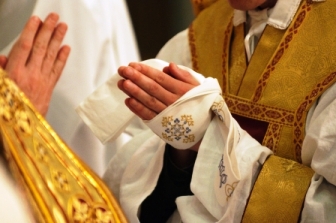
The manutergium pictured on Fr. Z's posting
 
Fr. Z decided to respectfully turn this area of minutia to the comment box, as he was unfamiliar with this tradition. The combox poster, a Fr. Maurer of Washington, U.S.A., who has his own blog, "Followers of the Way", was able to add the details of this tradition in co-operation with a seminary colleague of his. Reposted from the comment of January 13, 2012 in the linked Fr. Z post:
 
 
Gift of the Maniturgium and 1st confessional stole

On the occasion of their first Mass, it is traditional that the newly ordained priest presents a gift to his parents.

To his mother he gives the Maniturgium , which was used to cleanse his hands; consecrated and made holy when the bishop anointed them with sacred chrism at his ordination. The Maniturgium is a simple white piece of linen that represents the burial shroud of Christ that protected His sacred body during His 3 days in the tomb. The Maniturgium is given to the mother, because she was the first protector of the newly ordained priest, during his time in her womb. The Maniturgium is a reminder to the people of God of His love and protection – especially towards His priests. When the newly ordained priest’s mother is called home to God, she is buried holding the Maniturgium so that all in Heaven and on Earth will know that she is the mother of a priest. And on the last day when we are raised from the dead, she can present the Maniturgium to Christ the Lord and say, “my son too shared in your priesthood.”

To his father, the priest presents his first confessional stole. The stole is the sign of priestly office, and the priest wears it when he engages in holy things, like celebrating the Holy Eucharist and the Sacrament of Penance. In the Sacrament of Penance, we experience God’s justice, mercy and reconciling Love. It was the father of the newly ordained priest who first taught him about justice and mercy. And so the purple stole used to hear confessions, where the priest reconciles the faithful into God’s love, is presented to the priest’s father. And like the mother of the newly ordained, when the priest’s father dies, he is buried holding the purple stole so that all in Heaven and on Earth will know that he was the father of a priest. And on the last day when we are raised from the dead, he can present the purple stole to Christ the Lord and say, “my son too shared in your priesthood.”


While I cannot find if there are any specific prayers in the Ordinary of the Mass as part of this tradition, Of interest, There is some web content about this tradition, and it is even re-appearing in the Novus Ordo!
 
http://blog.adw.org/2010/06/lost-liturgies-file-the-maniturgia/ - Diocese of Washington, from Monsignor Charles Pope! A YouTube video of the part of the N.O. ordination rite with the manutergium is attached.


Enjoy. Pax, Julian.  
 

Thursday, 25 July 2013

More Good Stuff from WYD: The EF Side of Things

Hello Everyone.

On this rare occasion of linking to the heavy right-leaning Rorate Caeli, I just had to pass on something from WYD RIO. It's not all clowning around and childish things and poo-pooing that dreaded "Novus Ordo Church". Take a look at this!


http://rorate-caeli.blogspot.com/2013/07/juventutem-images-of-pontifical-mass-in.html

See that? That is a full church with a Pontifical Mass of all things at WYD RIO! We're talking a Mass with the celebrant being a bishop, with lots of young people!!! The fact that this is happening admist WYD RIO is a great sign! This is being made possible or co-sponsored by Juventutem Niteroi. And there's more here to come today and tomorrow: http://rorate-caeli.blogspot.com/2013/07/wyd-rio-all-traditional-experience-in.html

Pax, Julian.

Wednesday, 24 July 2013

Some Decent Stuff Being Spoken About by WYD RIO 2013

Hello Everyone.

So WYD is going on in Rio right now. I am not there as I chose to keep one week off the end of each summer month and to go on an Extraordinary Form Pilgrimage in Quebec called Marie De Reine.
While this is going on, I've seen already some things of concern, such as the Domus Sanctae or the main altar being previewed as some ultra modern spaceship thing, and apparently, some priest celebrated Mass with the LAITY con-celebrating with the priest at the Consecration. Sigh, there's always a few rotten apples who will use ANY reason to be lie-berals with the liturgy/the Church/doctrine/theology. Always has and always will be.

However, there are some good things going on. Right now I am tuned into the Salt and Light (or to some, Pepper and Darkness) website which has live stream coverage of certain events and speakers. I am listening to a bishop (he has a cape of sorts on too) speak on things as part of a Eucharistic Adoration session. By the time I tuned in, he spoke about:
  • The Holy Eucharist in Adoration
  • That the Church was borne despite scandal: Peter cutting off a slaves' ear, Judas' betrayal, even the abandonment of Jesus by most of the disciples at His crucifixion. Only John was there of the 12. 
  • Addressed the fact that there has been scandal and things that have happened in the world that have made people doubt the Church.
  • That the Church gives us many gifts, IT TAKES COURAGE, that the pilgrims will go forth from WYD to do the Work of the Lord.
  • The missing of the "slap" from a Confirmation in his former diocese or parish in Sitka, Alaska, was asked by someone in attendance. On that note he went on about symbols, (e.g. Candles, incense ...), but made mention that they were symbols used within persecution/hiding in catacombs), and may be again symbols of persecution in future. Man that's a little bold for a "feel good Jesus-y" event to say to the youth. Guess he thinks these young people can handle some truth after all.
  • When we gather for Eucharistic Adoration, Christ has called us to be the Disciples of today, and that we go forth, when we speak, we speak with clarity. When the moral voice is shared, it is shared with Charity. It is important we do all things with Love [The theological virtue of Charity].
  • In the invitation to be here at WYD, Benedict XVI said ...: "The celebrated statue of Christ the Redeemer .... will be an eloquent symbol for us. Christ's open arms are a sign of .... immense love for each and every one of you. Let yourselves be drawn to Christ, along with the other young people .... accept Christ's love ...." (I didn't get all the words, I typed this as the bishop spoke).
In addition ... a number of my generation/JPII generation Priests, do attribute their vocations to WYD. Despite some goof-ups, maybe it's not all bad after all. Besides, a good portion of my Newman Center U of T friends are down there right now as pilgrims/volunteers! I know one of them is a Latin Mass attendee I've seen on occasion when I've gone to Holy Family in Parkdale, Toronto! I pray for their safety. Pray for the pilgrims, that they will be disciples for the Lord, and carry out the New Evangelization with courage.

Pax, Julian.

Q and A for the Latin Mass Part II No. 5 - From the Pater Noster Until the Post Communion Ablutions and Prayers

Q and A for the Latin Mass Part II No. 5 - From the Pater Noster Until the Post Communion Ablutions and Prayers


NO. 5
C. Pater Noster Till Ablutions
25. The Pater Noster
26. Libera Nos and Fraction of Host
27. Mixture of Body and Blood
28. Agnus Dei
29. Prayers for Holy Communion
30. Communion of priest and faithful.
31. Prayers during ablutions
32. Communion-verse
33. Postcommunion Prayers

25. The Pater Noster

Is this in the Novus Ordo? Yes. 

Cues for the Laity:
  • LOW MASS: Everyone will be kneeling for this part. Near the end, after "Et ne nos inducas in tentationem", in the Low Mass, the server will reply, ``Sed libera nos a Malo.``
  • HIGH MASS: in the higher level Masses from Missa Cantata up, the laity stand. At the end of the priest`s recitation or the singing of the prayer, ALL reply, "Sed libera nos a Malo."
  • In all levels of the Mass, the priest will say Amen after.
 
General Gist: The priest and the choirs at High Masses and higher, say and/or chant the Our Father in Latin. The priest raises his voice and recited the prayer aloud with his arms extended

Relevance: 
  • This is, of course, the specific prayer that our Lord gave to the Apostles, as well as to all of us, to pray to his Holy Father in Heaven. We find this scripturally starting in Luke 11:1-2 when one of His disciples asked Christ to teach them how to pray.

  • Further, it is used by the Church on all solemn occasions, and is our support. Before this, in the Latin, is contained mention that we are "instructed by Thy saving precepts", and that we "dare" to say (just like in the Novus Ordo) the prayer. We dare to speak it, because we rely on the very precept which we have received so to pray, a precept given us by our great Master for our salvation (169, The Holy Mass).

  • In the Lord's prayer, the first three petitions (after: Pater noster, qui es in caelis:) regard God Himself: Hallowed be His name, may His kingdom come, and His will be done (169, ibid).
    • May His name be hallowed (sanctificetur nomen tuum:), as it deserves the appropriate honour and respect it deserves, as it His very right.
    • May his kingdom in Heaven come (adveniat refnum tuum:), that His reign be established in all and over all, as He is truly King.
    • His will be done (fiat voluntas tua, sicut in caelo, et in terra.), by men on earth, as it is in Heaven by the Angels and the Blessed.

  • Next in the prayer, come four petitions, for those things necessary for our salvation (169-170, ibid):
    • Give us this day our daily bread (Panem nostrum quotidianum da nobis hodie): This is stated in daily intervals, because we cannot know what will lie ahead each day. We may die tomorrow. Hence daily bread. While we also need our daily physical nourishment, the "bread" is also in the sense of spiritual nourishment: The Eucharistic Body of our Lord Jesus Christ, on the Altar.
    • And forgive us our trespasses (et dimitte nobis debita nostra,): Because we are sinners before God, to forgive whatever we have done against Him
    • As we forgive those who trespass against us (sicut et nos dimittimus debitoribus nostris): we ourselves mark the measure of the pardon we ask of God by begging Him to forgive us as we forgive others who sin against us.
    • And lead us not into temptation (Et ne nos inducas in tentationem,): That is to say, ward and defend us when we are tempted by our concupiscence, or the devil and his minions, to kill our grace with our God, or to wound our relationship with Him and disobey his will. Yes, God, in His designs, does allow us to experience temptation and be tried, in order to gain merit, we still ask Him for his aid because we are so weak and easily fail Him.

  • We finally ask him to deliver us from evil in the response given by all at the Mass in Missa Cantata or higher ``Sed libera nos a Malo.`` In this response, we ask to be delivered from the evil one, who constantly seeks to sin and fall so that our souls are wounded or worse, separated permanently from God in the afterlife. Moreover, if we have committed such evil, we beg of God mercifully to withdraw us from its grasp. (171, ibid)

  • It is after the prayer of the Our Father that the actual Communion of the Mass is considered to begin. (157, The Latin Mass Explained)


26. The Libera Nos and the Fraction of the Host and 27. The Mixing of the Body and Blood
 
Is this in the Novus Ordo: Yes, though reduced from what it is in the Extraordinary Form.
 
Cues for the Laity:
Low Mass: None. Remain sitting. The server gives the responses.
High Mass: At the end of `per Omnia saecula saeculorum`, ALL say: Amen. After Pax domini sit semper vobiscum, ALL reply ``et cum spiritu tuo.`` The laity kneel after this response.
 
General Gist: The priest takes the paten between the first and second finger and says the Libera Nos prayer. He uncovers the chalice, genuflects, takes the host, and breaks it in the middle over the chalice, saying another prayer. He breaks off a particle from the divided host, says `per Omnia saecula saeculorum` with a reply of Amen from the server/people. Then he makes the sign of the Cross (3x) with the particle over the chalice saying ``Pax domini sit semper vobiscum`` to which the server/people replies ``et cum spiritu tuo.`` The Host is broken in half and a particle is dropped into the Precious Blood.

Relevance:
The Libera Nos
  • ".... Communion is the means taken by Our Lord to unite all men one with the other, so as to make of them all, one whole .... In order to express this union, Holy church wishes that the result of that charity which reigns amongst the faithful, should be the object of very special attention. So now, she is about to ask it, in the following Prayer; [the Libera Nos] ...." (171-172, The Holy Mass).

  • The priest asks at the beginning of the prayer, from Libera nos to et futuris, to strengthen us, because our past evils have caused us to contract spiritual weakness, and we are as yet by convalescents. Deliver us from those temptations which weigh us down spiritually, and others sins we're guilty of, and what may seek to allow us to fail again in future (172-173, ibid).

  • Next, it is asked by mercy and intercession of the Saints, including in particular our Holy Mother, Peter and Paul, and St. Andrew.
    • Here, the priest makes the Sign of the Cross on the Paten. He does so because it was by the Cross that Christ became ``our peace`` by the shedding of His blood upon the Cross (cf. Ephesians 2:14). (158, The Latin Mass Explained).
    • After kissing the paten, the Sacred Host is placed upon it. The paten with the Host then is placed to the right of the Chalice, to indicate that blood and water issued forth from the opened side of our Redeemer. (ibid)
    • Why specific reference to St. Andrew? The Holy church has had a very special devotion to this apostle since early Christianity in Rome, because he was the brother of St. Peter. Also, St. Andrew is connected to peace because his martyrdom resembled very much the Passion of Christ, in virtue whereof, peace is given to us. (173, The Holy Mass; 158, The Latin Mass Explained.)

The Fractionation of the Host & The Mixing of Body and Blood
  • After the Libera Nos, the Chalice is uncovered, and the Host is broken in the middle. A small particle goes into the chalice from one of the halves. The priest is also imitating our Divine Saviour, when he did the breaking of bread at the Passover Seder, (159, The Latin Mass Explained) instituting the Priesthood and Eucharist.

  • The little particle is dropped into the Host, and the breaking of the Host, has symbolism (160-161, The Latin Mass Explained).
    • The breaking in half, represents the breaking of his humanity (in his crucifixion and death).
    • The Peace of the Lord, Christ merited for us though the Sacrifice on the Cross. The Host broken over the Chalice indicates the Precious Blood flowed from the bruised body of Christ.
    • The particle dropped into the Precious Blood shows our Lord's Body is not without His Blood, nor vice versa. Because we see them as separate species with the accidents of bread and wine, we might not believe in the Real Presence, or that the Body and Blood do not co-exist. The co-mingling dispels this illusion, reminding us that under such appearance, the one, living Victim of the Cross is present.
    • This part of the Mass also reminds one of the dual nature of Christ: Divine and human in his Incarnation.

28. The Agnus Dei

Is this in the Novus Ordo? Yes. And in certain Novus Ordo Churches ... you might even get to hear it sung in the original text, in Latin!

Cues for the Laity? The Laity remain kneeling.

General Gist? The Priest repeats the words of St. John the Baptist. "Agnus Dei, qui tollis peccata mundi, miserere nobis." The priest covers the Chalice, genuflects and rises: then bowing down and strikes his breast each time he says the Agnus Dei. The altar servers should also have their heads slightly bowed as well.

Relevance:
  • In this thrice repeated part of the Mass, the priest repeats the words of St. John the Baptist, who proclaimed the Messiah to the Jews. In the old laws of sacrifice in Judaism, an unblemished lamb was used to atone for sin (and also, don't forget, lamb's blood was used for the Passover to indicate Jewish houses to the Angel of Death in the Book of Exodus). In the New Law, the heavenly Lamb, takes away the sins of the world. (41, Latin-English Booklet Missal).

  • Also in the repeating of this prayer, the Church wishes to teach us how ardently and fervently we should desire to pray for peace of the Lord, and remission of our sins and all punishment due to them (161-162, The Latin Mass Explained). The priest is also striking his breast like in the Confiteor as a physical sign of repentance to this effect.

  • The third time, the last words in Latin are "Dona nobis pacem" and not "miserere nobis" as the Eucharist is the Sacrament of peace, by means of which all the faithful become united together. (177, The Holy Mass).

29. Prayers for Holy Communion
Is this in the Novus Ordo? Yes. The third edition of the Roman Missal has these prayers even closer to the original translation of the Latin. However, the first prayer in the EF, is said before the Agnus Dei as the prayer before the "Sign of Peace" in the Novus Ordo.

Cues for the Laity? At all levels of the Mass, you are still kneeling.

General Gist: The Priest, with his eyes toward the Blood and Body of Christ on the altar, prays the "Prayer for Peace and Fidelity," "The Prayer for Holiness", and the "Prayer for Grace". This is before his own communion. Should the Mass level be a Solemn Mass, then the clergy and highest ranking servers will do a "Pax," two specific members at a time. This is not the shanking of hands but as I coin it a "fraternal, light, bear hug" with each other, which is very cordial and reverent at once.

Relevance:
  • The Prayer for Peace and Fidelity
    • This is a humble petition for the blessing of peace for the Church. (164, The Latin Mass Explained)
    • There is also the implication of peace with fellow man in this prayer (which takes from Romans 16:16), and in fact peace with man is done today in the form of the Pax in Solemn and Pontifical level Masses. In these Masses The priest gives the Pax to a deacon, who then gives it to the sub-deacon, who gives it to any priests in choir, who then pass it onto the highest ranking servers. (178, The Holy Mass)
    • The priest will also kiss the Altar, in front of the Sacred Host, whereby the Lord gives him. (ibid)
    • The Pax is NOT done in Requiem Masses, Maundy/Holy Thursday, and Holy Saturday. With Holy Thursday, it's a protest against Judas' kiss of betrayal to Christ. With Holy Saturday, it is omitted as it was not till Christ was Risen, when he greeted his disciples saying "Peace be with you, or Pax Vobis". (178-179, ibid)

  • The Prayer for Holiness
    • This prayer expands the final words of the Lord's Prayer and implores peace. (41, Latin English Booklet Missal)
    • This is one of the two prayers for direct preparation for Holy Communion. The priest is about to receive Christ in the Eucharist, both his humanity and divinity and professes in the liveliest of faith: O Lord, Jesus Christ, Son of the Living God. (165, The Latin Mass Explained)
    • He also professes in the redeeming of the Blood of Christ, asking of the Lord's Blood to "Deliver me by this Thy most sacred Body and Blood from all my iniquities." This prayer, though said silently and inaudible to the Laity (but can be read via a full 1962 missal,) reminds us that the work of the Redemption was accomplished by Christ "according to the will of the Father" and "though the co-operation of the holy ghost." (ibid; 180, The Holy Mass). We should also desire the same remission of our sins that the priest does in the Holy Eucharist as well, when we approach for communion. (180, The Holy Mass).

  • The Prayer for Grace
    • While this prayer deals only with the Body of Christ, not the Blood, it nonetheless is important to both priests and laity. Holy Mother church is so completely occupied by the sacrifice on Calvary, that she recoils from renewing it on the altar. Therefore, She confines herself to partaking of the sacred mystery by communion. (182, The Holy Mass)
    • In addition, this prayer can very appropriately be used by the faithful when about to communicate. (ibid). How so? It is quite similar in idea to the response at the Novus Ordo before the faithful communicating, but with more content.
      • It claims us (the priest) as unworthy to receive and also includes judgement and condemnation as to consume the Eucharist unworthily, as proclaimed to us in Scripture in Paul's Epistles constitutes Mortal Sin: NRSV 1 Cor 11:28-29: "28 Examine yourselves, and only then eat of the bread and drink of the cup. 29 For all who eat and drink[a] without discerning the body,[b] eat and drink judgment against themselves. "
      • It is hoped that by the Lord's mercy, it becomes our safeguard and healing remedy of soul and body (of which the Eucharist is. It does have the ability to remit venial sin upon consumption, AND it is our spiritual "nourishment as it were. Further how many a time, and clergy member, has stated that by the sacraments we remain close to Christ and are able to deal with our spiritual struggles, especially spiritual combat?)
30. Communion of priest and faithful.
Is this in the Novus Ordo? Yes.
 
Cues for the Laity?
  • You are to remain kneeling.
  • After the priest reveals the host to you by turning around, saying "Ecce agnus dei ..." You, the altar servers on your behalf, or the priest alone, might reply back publically with "Domine Non Sum Dignus (DNSD) ut intres sub tectum meua: sed tantum dic verbo, et sanabitur anima mea" three times.
  • When it is time to receive communion, you are to proceed and line up at the altar rails/makeshift rows using prie-deuxs, the first pew, etc. You receive the Eucharist on your tongue AND kneeling, but do not say "AMEN" after the priest speaks in Latin the words "Corpus Domini Nostri Jesu Christi custodiat animam mean in vitam aeternam. Amen." 

General Gist:
  • After the priest has said the communion prayers, he will then genuflect and take the host. He says a prayer in Latin that are a free rendering of Psalm 125 (182, The Holy Mass).
  • While striking his breast, he says the response before self-communicating, which is in Latin what you would say in English in the Novus Ordo Masses with the 3rd translation of the Roman Missal. This prayer is, in Latin, the DNSD.
  • He will then consume the Host, ensure minor particles are collected into the chalice, and then will self-communicate with the species of the Blood of Christ.
  • If permitted, the altar servers will say a second Confiteor and the priest will repeat the prayers said in the first half of the Mass after the Confiteor. He then turns toward the people, elevates the host, and like in the Novus Ordo but in Latin, says "Behold the Lamb of God, behold him Who taketh away the sins of the world."
  • You might be permitted to say the DNSD publically, but if not, then the altar servers might do that for you, or the priest alone. At the High/Solemn level Masses, the servers usually say this response publically.
  • The priest then allows the servers to take Communion upon the altar, from right to left, with each server using the paten while receiving, and passing it along to the next server.
  • The priest, with the server or left server at Low Mass, or the MC (+ Deacon) at the higher level Masses, will then take the paten(s) and serve communion to the Laity. The laity kneel and receive on the tongue at the designated altar rails or area, without replying Amen after the priest speaks.

Relevance:
  • Well, this is obviously important as you are consuming the Body of Christ. Again, if you are not a baptized Catholic, or you are a Catholic who is NOT in the state of Sanctifying Grace/in the state of mortal sin (e.g. murder, excommunicated, masturbation with/without pornography, co-habitation before marriage or after re-marrying OUTSIDE of the Church [no annulment ...],) THEN DO NOT RECEIVE. In addition under the current Code of Canon Law (1983) of which is in force, communicants must abstain from food and drink (save water) for at least one hour before consuming the Eucharist.

  • Should one not be able to receive the Eucharist due to not being a Catholic, being in the state of Mortal Sin, OR having broken the fasting rule, they can offer up a spiritual communion instead. Here is one for such a purpose:
    • My Jesus, I believe that Thou are in the Blessed Sacrament. I love Thee above all things, and I long for Thee in my soul. Since I cannot now receive Thee sacramentally, come at least spiritually into my heart. As though Thou hast already come, I embrace Thee and unite myself entirely to Thee; never permit me to be separated from thee.

  • When the priest takes the host before his DNSD, he refers to the Eucharist as the Bread of Heaven in his prayer. This is an allusion to the manna give to the Israelites in the desert, which was a figure/precursor/foreshadow of the Eucharist. He is also calling upon the Name of the Lord, which has its Scriptural Roots in the OT in Psalm 114:3-4 (167, The Latin Mass Explained).

  • The DNSD prayer are the words relayed by the friends of the deathly ill centurion, who in Luke 7:6-7 felt unworthy to have Jesus heal him: (NRSV) "6 And Jesus went with them, but when he was not far from the house, the centurion sent friends to say to him, “Lord, do not trouble yourself, for I am not worthy to have you come under my roof; 7 therefore I did not presume to come to you. But only speak the word, and let my servant be healed."
    • At the priest's utterings and thrice-fold repeats of this prayer, the altar server rings the bells, once per DNSD, though at a High/Solemn Mass, sometimes the number of rings increases by 1 each time. The bell ringing indicates this is an important part of the Mass and to excite your attention (168, The Latin Mass Explained).
    • Implicit in this prayer is our own unworthiness to receive the Lord as he is the Word made Flesh, but we are sinful and of human frailty. (ibid).
    • We say this prayer at Mass, because it is our own poor soul craving help for itself, and making use of these words, is a last appeal to God. We sorely need to be cured. As the Healer of all Healers, we must appeal to Him, and crave Him with true humility. (182-183, The Holy Mass).

  • In the priest's saying to us before we communicate, the last few words of the Latin are in vitam aeternam, that is, in life everlasting. This is such, because One Communion would of itself be sufficient to preserve our soul unto Life Eternal, for such is the intrinsic efficacy of tis Divine Sacrament, provided for our wants by God. (184, The Holy Mass).

  • While the priest is scraping the leftover particles of the Host into the Chalice, he asks himself what return he will make to the Lord for all He has given him? He can only reply that he will take the Chalice of salvation and call on the Name of the Lord.
    • Again, with the name of the Lord, it refers to Psalm 125 Scripturally
    • When the priests asks himself what to give for what God has given him, God in His infinite love has given an infinite gift in the Body and Blood of the Lord. God, in giving us the Lord Jesus, who sacrificed Himself for our sins, gave us everything in this act of infinite love.
    • What can the priest give? God has no need for our goods (cf. Ps 15:2). All the priest can give in return is what he has been given, the Chalice of salvation, and so to God we can accept his gifts with kind and loving heart as sufficient thanks (170-171, The Latin Mass Explained.)
    • The priest makes the Sign of the Cross over himself with the Chalice, to indicate again that it is from the Cross of Calvary that the redeeming grace of our Lord's blood flows upon us. The priest consumes under both species as he must consume the Sacrifice, which was offered up under the two species. "Do this in memory of me." (ibid)
 
 
31. Prayers During Ablutions
Is this in the Novus Ordo? Yes, there is one prayer said while purifying the chalice. For reasons unknown to me, wine is not used in the ablutions in the N.O., only water.


Cues for the Laity? You should be kneeling at this point, especially after having communicated. You are praying surely to the Lord after receiving him in the Eucharist while things are going on?

General Gist:
  • After the priest places the remaining particles into the chalice from the patens used at communion, he will purify the chalice and cover it up.
  • After the leftover hosts/ciboria are placed back in the tabernacle, the acolyte(s) will get up and pour some wine in to the chalice, the priest will drink it and say the Quod ore sumpsimus prayer, in what is the first ablution.
  • Then the servers will pour wine and mostly water, over the priest's fingertips in the chalice. The priest drinks the remainder of liquid and wipes it clean, in what is the second ablution. He wipes his fingers with the purificator prior to consumption, and dries the chalice with the purificator.
  • The servers/MC/deacon help to "rebuild" the chalice with the priest after the ablutions. In addition the MC/acolyte will transfer the missal back to the Epistle side.


Relevance
  • In the first ablution, the priest is asking that our Communion is both physical and spiritual, that is, productive of grace in our souls, and that partaking in the Sacrament of the Eucharist in this life, may being eternal happiness in the next. (174, The Latin Mass Explained). Also in the prayer is reference to the Eucharist as temporali fiat, a temporal gift, as while God is eternal, this Communion is taking place at a specific point in time. By means of this temporal gift, Our Lord achieves the union of soul with Himself. The Lord uses this Singular Act as a remedy for our souls. (186, The Holy Mass).

  • In the second ablution, we ask that we experience the efficacy of the Sacrament of the Eucharist. We ask it cleaves to its inmost parts of our soul, which are understanding, free will and memory, with cleaving meaning that it remains there for a long period of time. (175, The Latin Mass Explained). Also that it removes from us our sin (save lingering Mortal Sin, which is only removed upon Reconciliation). Also water is co-mingled with the wine, as the Blood of Our Lord is no longer there [as what the server poured in is unconsecrated wine.] (187, The Holy Mass).

  • Why the ablutions anyways? It is mainly out of respect for the Holy Eucharist (175-176, The Latin Mass Explained).
    • The wine and water are poured in and consumed to remove all existing traces of both species of Christ.
    • Water is poured over his fingers to remove any trace particles of Eucharist from the priest's fingers. Until such time at the 2nd ablution, he remains with hands folded/fingers pinched at the forefingers so nothing is touched with those finger, where the priest used those fingers to handle the Sacred Host. He does not want any leftover parts of the Eucharist to be left on anything else.
32. Communion Verse
Is This in the Novus Ordo? Partially. The antiphon portion is present in the N.O., but only a "postcommunion" prayer is present. The antiphon is often ignored in the Novus Ordo (sadly.)

Cues for the Laity: Before the responses, you are kneeling, and continue to do so for the Low Mass. At the high Mass and higher, you will stand at the responses between Priest and server.  

General Gist: After the priest has finished the ablutions, he goes to the Epistle Side [where the Missal has been transferred since] and reads the communion verse/antiphon from the Missal. He then goes back to the middle of the altar saying "Dominus Vobiscum" with the reply being "Et cum spiritu tuo." The priest says "Oremus".

Relevance:
  • When the priest says domunis vobiscum to the laity, he gives expression to his desire that the Lord Whom they have received, may always abide in them, according to His own promise in John 6:57: "He that eateth My Flesh, and drinketh My Blood, abideth in Me, and I in him."

33. Post Communion
Is This in the Novus Ordo? Yes. It also is a changing prayer for each day. It is tied with the Communion antiphon, but the prayer itself is simply titled, the ``Prayer after Communion.``

 
Cues for the Laity: If it is a Low Mass, you still are kneeling. If it is a High Mass or higher, you are still standing after the responses.
 
General Gist: The Priest returns to the Missal and prays once more. In number and subject the Post communion corresponds with the collect and the secret (178, The Latin Mass Explained). After the prayer, the server (sometimes laity) reply "Amen", and the D.V. and E.C.S.T. reply take place again.
 
Relevance:
  • The prayer portion of this part always mentioned Communion that we have just received (188, The Holy Mass; 178, The Latin Mass Explained).
  • This prayer is an act of thanksgiving and reminds one of Colossians 3:17: "All whatsoever you do in word or in work, do all in the name of the Lord Jesus Christ, giving thanks to God and the Father by Him." (178, The Latin Mass Explained).
 

Works Cited
1. Moorman, Msgr. G.J. The Latin Mass Explained. Tan Publishing: Charlotte, North Carolina, U.S.A. 2010.

2. Gueranger, D.P. The Holy Mass. Baronius Press Limited: London, United Kingdom. 2005.
3. Coalition in Support of Ecclesia Dei. Latin-English Booklet Missal for Praying the Traditional Mass. Coalition in Support of Ecclesia Dei: Glenview, Illinois, USA. 2008.

4. The Ordinary of the Mass. The Daily Missal and Liturgical Missal with Vespers For Sundays and Feasts From the Editio Typica of the Roman Missal and Breviary, 1962 With Supplements Containing The Additional Masses for Englang and Wales, Scotland, United States and Australasia. Summorum Pontificum Edition. Baronius Press: London. 2009.

REMINDER: Latin Mass Serving Group Practice This Friday July 26, 2013 8pm at St. Lawrence

Hello Everyone.

This is just to remind you of the open, Latin Mass altar serving practice this Friday evening at St. Lawrence the Martyr, Scarbourough, at 8pm.

Please see further details here: http://torontotlmserving.blogspot.ca/2013/07/annoucement-july-26-2013-practice-for.html

If you are interested, though you are not on my usual mailing list, please send me an e-mail under the contact page ASAP.

Pax, Julian.

Sunday, 21 July 2013

Off the Beaten Path: Raising a Large Catholic Family, Even Without the Latin Mass

UPDATE 23/07/2013

While on the theme of parenting and raising a well-adjusted family, this article popped in my Facebook news feed. Traditional Catholic culture and manliness do intersect in a number of occasions, and this is one of them:

http://www.artofmanliness.com/2013/07/22/family-culture/

Once you read though this article, you can clearly see that the Catholic Traditional attitude and practice of raising a family, contains many of these principles and more, superseding material bounds and limitations. Still, even lukewarm Catholic parents to be and families could benefit from the advice in the article. It's not just a "trad" thing.

On a side note, Art of Manliness is an excellent site for learning about, and reclaiming, traditional men's culture, values, etc. Definitely look around.

----------------------------------------------------------------
Hello Everyone.

On occasion, I do delve into things that are centered around Traditional Catholicism, but are not directly related to the Latin Mass, the culture if you will. Many posts ago I highlighted something on Catholic Parenting.

While I personally detest the hard line ``Mad Trad``/SSPX sympathies of this blog, Rorate Caeli does provide a source of online TLM news and often features Latin Masses that are done. In addition to when they are not allowing content that I detest, they produce a "diamond" on occasion. That "diamond" today, is in an account of a family who explains how they raised their kids Catholic, and how their kids KEPT the Catholic Faith. This is part of an ongoing request for large, Catholic, Traditional, homeschooling families to show it can be done in this messed up modern world.

The original link is here: http://rorate-caeli.blogspot.com/2013/07/guidance-for-young-parents-how-to-raise.html

Still, I am going to repost this in full. I think it's entirely important to do so, because it's an all encompassing post, and there is much needed into TRULY having a Catholic Family, not just one or two main things. Important points will be in bold and my commentary in square brackets.

The only reason I'm writing you is because young families DO need inspiration.

I thought I could add a tidbit to the "inspiration" because thanks be to God, our children turned out well, with no heartaches and a great spiritual "togetherness". The hardest part is letting go, but they belong to God in the first place, anyway.

We are a very private family (NOT outgoing) and we are NOT a large family (as you requested) NOR EVEN a homeschooling family (as you requested), so we don't fit the mold but it takes all kind of families to raise good children in good Catholic environments. 

We only had 5 children (we married late in life 30 and 33). 3 are priests with the FSSP, a married son with 7 children (they homeschool) and our daughter-in-law has 2 Catholic blogs and a married daughter with 6 children (they also homeschool). Son-in-law teaches at a Traditional Catholic Opus Dei boys school. They both graduated from TAC (Thomas Aquinas College in Ojai, Calif.) Some of these 13 grandchildren already talk of vocations. [As you can see, right of the bat, the parents were NOT of the traditional Catholic homeschooling, Latin Mass stereotype. There CAN be vocations even to the EF wings of the Catholic Church from ordinary Catholic families. continue on to see how they did it ...]

Since our engaged days my husband and I both agreed that only one thing mattered. Getting each other to heaven and getting our children (whatever children God sent us) to heaven.
 
The first outing for each of our children was going to Mass. They were baptized ASAP. [God and their souls first.]

They learned to kneel and bless themselves for nightly prayers before or at the same time that they learned to walk. They went to "Catholic" schools but we stressed that they were there for education and because they had more discipline than public schools. They were not there for catechism or to learn their Faith, this they would learn at home.

They learned their catechism at home from the Baltimore Catechism. They knew it better than the "Catholic" teachers and nuns, who more often than not only taught "social" messages. (Sandinistas, wishy-washy "Love", Church of "Nice"), while their orthodoxy was ridiculed or slighted before others, but they learned to endure and forgive though they suffered as the "odd man-out" in school. They learned "white martyrdom" at a very young age. 

The boys quit serving Mass when girls were introduced as altar girls, and a few other boys followed their lead. The girls were then delegated to helping set up the altar linens and other tasks. Some of their mothers complained but the boys came back. Unfortunately in later years, when our boys were long gone, this policy got re-established.

At Mass when very young, though they could not read, we let them hold the missalettes and pointed to where we were at that point in Mass. They behaved better than a lot of adults who wanted to Kootchi-Koo them and we would turn their heads to the front reminding them that Mass is in front not in the back or the people around them. Though we only had Novus Ordo Masses we taught them to fight the distractions. 
[Again. They did NOT have the TLM to help them. They did this all in the Novus Ordo Mass. The KEY difference is they taught even while young the emphasis of what was happening there, and not feeding them cheerios and toys and letting them run loose. They were disciplining them to worship our Lord in the Mass. They did NOT indulge their children's selfish whims.]

It wasn't until they were grown that they had the opportunity to attend the TLM Masses and they learned to really appreciate them.   

We looked upon them not so much as OUR children, but GOD'S children that had been confided to our care and we raised them as God's children. Its like they were a blank cassette (nowadays it would be CD or DVD) and they would pick up from us whatever they heard and saw.

We just raised them as Catholics are supposed to be raised. Nothing out of the ordinary.

Saying the Rosary, making visits to the Blessed Sacrament, dressing properly for Mass Sundays and occasional weekdays, regular confessions, morning and evening prayers.

But we were an ordinary family, Boys Scouts, Girl Scouts, Piano, Guitar, various summer sports (swimming, baseball, tennis, soccer etc city-sponsored stuff) and picnics with trips to zoos etc., just our family with an occasional friend. Almost no TV: mostly "Mr. Rogers".  

They learned to discern at an early age and if I had the radio on because I could not hear the words only the tune, they themselves would turn it off and tell me "that's a bad song, mom". 

If we got angry with them when they misbehaved or went off the track, we would explain why we were angry and apologize but explain that it was our duty to teach them, their duty to learn and that only one thing mattered : "doing God's Will". 
[So Important!!!!! See my commentary in the bullet points below]

People at our Parish ask us "What did you do?" We can't really tell them except we're an ordinary family bringing up God's children the way God would expect us to. 

We saw our children as a grave responsibility and we only get one shot at bringing them up. Start guiding them from the day of their birth for as the sapling grows so grows the tree. 

I was frightened at the grave responsibility and when each was born I placed them in Mary's hands and asked her to help me bring them up. So it really is more her doing than my husband's or mine.

In summary, marriage is between 3 people, not 2, God being the head of the other 2.
------------------------------------------------------

In my evaluation, were I to give a bullet point list of what this family did right to raise their kids Catholic and KEEP THEM CATHOLIC, Here it is:
  • They did not treat marriage as an everlasting bliss. They committed to their Marriage as a SACRAMENT, not a special occasion or milestone. "... marriage is between 3 people, not 2, God being the head of the other 2."

  • They were open to life, as is supposed to be agreed to by the couple upon marriage in the Catholic Church. What is NOT SAID openly but implied, they did not abort, contracept with pills, condoms, etc., and had as many children as their biology allowed them to.

  • They both AGREED in full, that their obligation to their children was to instill in them the virtues and habits necessary to get to Heaven. This was their number one priority with their children, NOT making them future doctors, lawyers, etc. with large money-making jobs, or seeing them as the next professional athlete, or whatever the kids want to their hearts content. "We saw our children as a grave responsibility and we only get one shot at bringing them up. Start guiding them from the day of their birth for as the sapling grows so grows the tree. "

  • The majority of Catholic school education must NOT be trusted due to lukewarm Catholics being your teachers, warped by the same "Jesus loves everybody" garbage they were taught and most parents of today were fed in their schools. What must be taught to the kids is: "... they [are] there for education and because they had more discipline than public schools. They [are] not there for catechism or to learn their Faith, ..." If you are blessed with more money and possibly, private Catholic schools in your area or homeschool groups, then you could have your child in those if they are orthodox.

  • Furthermore, your spouse MUST be 100% committed with you, in teaching the true, unaltered Catholic Faith to your kids as parents, at home. This is EVERYTHING from gestures of prayer (e.g. genuflection to the tabernacle entering and leaving the main body of the church) ... to the Major doctrines and dogmas of the faith (e.g. Scripture, abortion, contraception ...). If your husband/wife to be is NOT 100% committed to this, you will either have major problems with her/him or your kids. It would be highly best to NOT marry them, and let them have their way with a lukewarm Catholic partner or someone not Catholic. This does NOT mean your future partner in marriage needs to be a stereotypical "trad" who will homeschool, but they must be 100% committed to the Catholic Faith with you.

  • You MUST prepare your children, and yourselves to undergo "white" martyrdom against your family, lukewarm friends, even their teachers, "role-models" and even certain CLERGY AND RELIGIOUS!!! You will be harassed, insulted, taunted, etc. by those who do not want to truly practice their Catholic faith or find your methods ``archaic`` for lack of a better word and have embraced the modern world and its parenting ideologies, and modern theologies.
    • NRSV Matt 10:34-36: "Do not think that I have come to bring peace to the earth; I have not come to bring peace, but a sword. 35 For I have come to set a man against his father, and a daughter against her mother, and a daughter-in-law against her mother-in-law; 36 and one’s foes will be members of one’s own household.
    • The last of the Beatitudes in NRSV Matt 5:11-12: 11 “Blessed are you when people revile you and persecute you and utter all kinds of evil against you falsely on my account. 12 Rejoice and be glad, for your reward is great in heaven, for in the same way they persecuted the prophets who were before you."
    • Basically, your family will be harassed and insulted for the Faith. If they are not prepared for the insults and harassment, you, collectively, will be too weak to withstand the teasing and will falter in your attempts, and maybe give up. This can be especially hurtful to the kids growing up, so they must be made strong while they are young.

  • You MUST teach your children that the Mass is NOT an obligation to just attend and go. IT IS THE HIGHEST FORM OF PRAYER TO THE LORD, AND DEMANDS YOU AND YOUR CHILDREN's FULLEST ATTENTION! In addition, you must not let your kids be distracted from it by toys and cheerios and teach them that their whims are not important ... JESUS ON THE ALTAR IS IMPORTANT!!!

  • "We looked upon them not so much as OUR children, but GOD'S children that had been confided to our care and we raised them as God's children. Its like they were a blank cassette (nowadays it would be CD or DVD) and they would pick up from us whatever they heard and saw." You must understand YOUR actions will affect your child's faith life and their conduct in the world. You are their primary educators and teachers of morals, the Catholic faith, etc. You cannot just leave others to teach your kids. YOU ARE THEIR BEST TEACHER AND ROLE MODEL and must have this idea of the "Tabula Rusa" in mind. You are the one with the stylus writing on their "tablets".

  • In terms of the parenting and their children's exposure/interests:
    • They did NOT allow their children to be exposed to the multitude of sinful, immoral programming and entertainment on the TV, Movies, etc.
    • They only went out with other trusted families or friends. Not mentioned: clearly, those who did not have similar ideas with regards to parenting, the faith, etc. or children with bad influences. They ensured that positive peers/role models with the utmost attentiveness to the Catholic Faith were allowed to be with their kids.
    • They allowed their children to pursue interests that would help them mature and develop their natural, God-given/Holy Spirit-given talents and abilities. They were not allowed to pursue those that would not do so.
    • They were allowed to pursue other interests in their spare time, period. They were not always having a constant infusion of Religion and faith 24/7 to the point of denying them even basic interests/friends/outings, etc. In other words, the parents were not extremely authoritarian.

  • "If we got angry with them when they misbehaved or went off the track, we would explain why we were angry and apologize but explain that it was our duty to teach them, their duty to learn and that only one thing mattered : "doing God's Will". This is important:
    • Parents are the earthly expression of God/Jesus' love for us. We get our understanding and our reflection of God through them. If the parents in general are not doing such, we will have a poor understanding of the Lord.
    • Children do need discipline to be able to not become selfish miscreants. The world doesn't 100% work that way. It has many a vice and means for being selfish and sinful/serving the devil while being a part of it, but it will not allow extremes such as wanton crime and murder, or anarchy. Without discipline, a person will have to learn the "ways of the world" the hard way, or "sink or swim". Not a good prospect.
    • On the opposite hand, if the child does not understand the discipline of the parents, or find it just to be for their selfish desires, they will rebel against the parents who did not discipline out of love, but out of cruelty or their selfish emotions.
      • I can personally attest to this. Growing up, I was made to dress up for Mass, was made to sit up straight in the pew, be quiet, etc. I was also disciplined through yelling and sharp comments upon immediate violation of rules or something that my parent's didn't like. I received no explanation for the actions (until recently as an adult). I only viewed what they wanted of me as following orders. I did not understand why to do all that for Mass, and they did not tell me what the Mass was truly all about. Their focus was also more on materialism in terms of jobs, success, etc. Is it no wonder when I went away partially to university (home on weekends) I didn't care as much about my studies and rebelled against my Faith? And if they do ever see this someday. I am 100% unapologetic for writing this. I came back and reverted to my faith, understood what the Mass was all about, dress up more and attend Mass willingly on my own, by doing this all myself, with support from youth ministries. My reversion was not of my parent's hands. And as for "well we gave you the basics so of course you came back", it sure didn't keep me there. I had to re-discover the Faith and choose this all on my own. The "training" failed.

And there you go. Enjoy the post and the bullet points.

Pax Tibi Christi, Julian Barkin.